Why not 10,6,6,…,6?
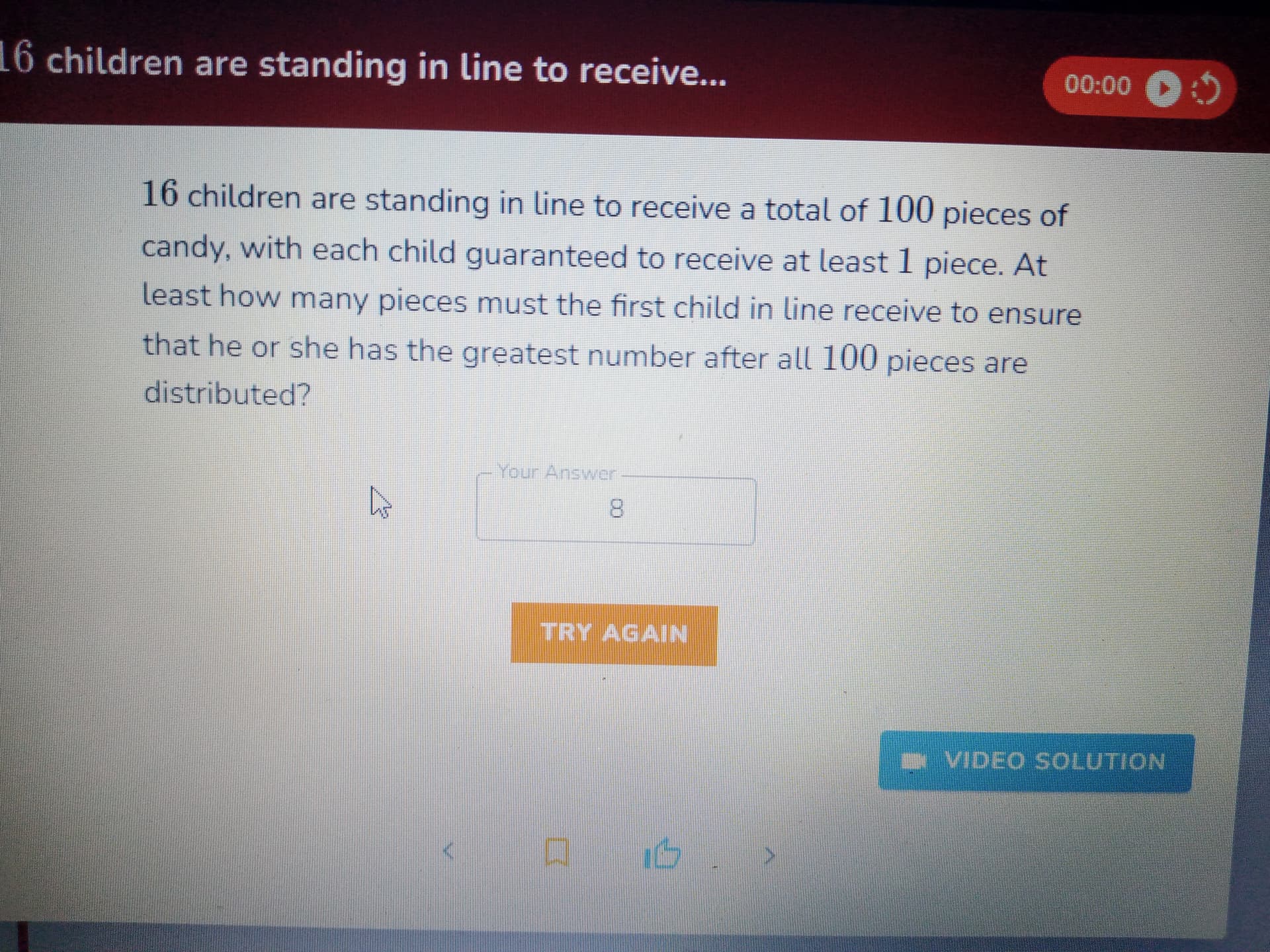
I think it is 44:
this leaves 66 candies for the remaining 15 kids. Now the 2nd kid will take the maximum amount he can take, so he will take 42 (leaving 14 candies for the remaining 14).
The answer would be 9 if I’m not wrong. The question is basically asking what would be the least number of chocolates that would guarantee the first child would have max chocolates.
First we distribute equally (max possible) — 16 * 6 = 96.
So now each kid has 6 chocolates. The 4 remaining should be distributed in such a way that the 1st kid would have max chocolates in all scenarios. So the least number that would work is 3. So 6 + 3 = 9.
Why 8 wouldn’t work is because if the first kid gets 8 then there are 2 chocolates remaining which could be given to any kid(who’ll also have 8 chocs now) which contradicts the condition that 1st kid should always have max chocs.