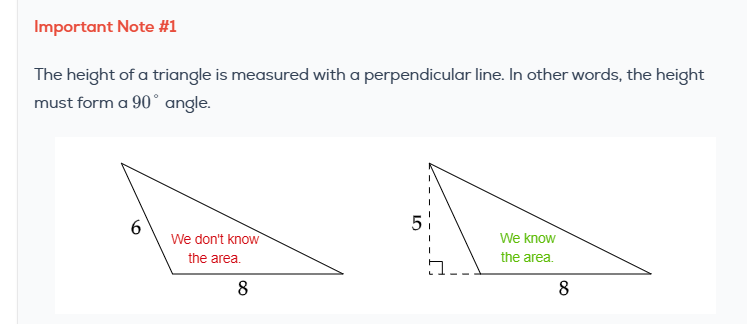
The “height” in the 2nd triangle on the right that is marked as 5 - is that given in the question, or is that something we made up?
How do we know the area of the original triangle? If the “height” is 5 (either by assumption or by question information), the area 1/2 * 5 * 8 gives the area of the entire triangle, including the area with the dotted extended lines. How do we calculate the area of just the original triangle (without any extensions)? And how do we “know” this? Was this covered in an earlier video (in the Prepswift Geometry series)?
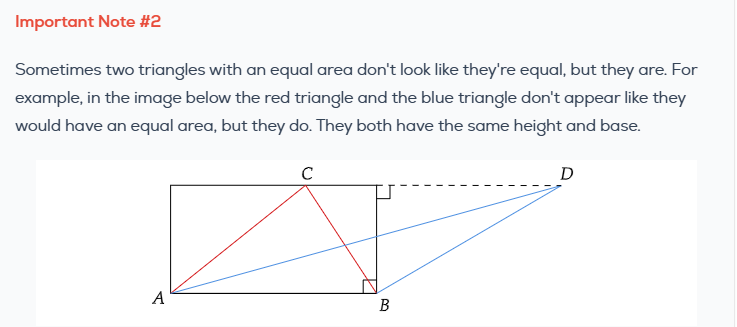
How is it that the red and blue triangles both have the same area? Is it implied, then, that any triangle drawn inside a rectangle/square will always have the same height ( = side of the rectangle/square)?
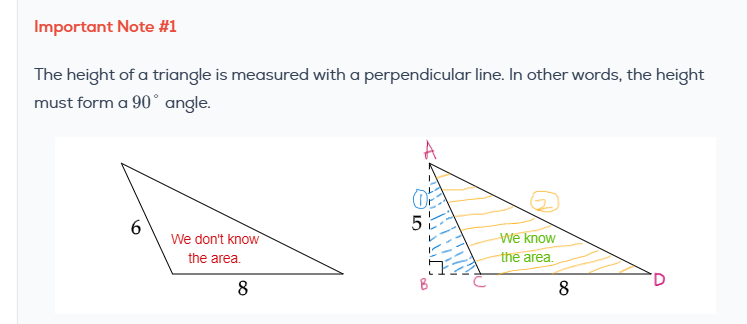
I was only referring to the triangle on the right throughout, but for clarity, I’ve marked the two regions: the blue dotted region (Triangle ABC, marked 1) where a perpendicular with height 5 has been added, and the yellow solid-line region (Triangle ACD, marked 2), which was the original triangle in the question (minus the extended lines AB and BC).
When I calculated the area of the triangle as 1/2 * 5 * 8, I thought this would indicate the area of the two regions/triangles (1 and 2) combined together, ie, triangle ABD, because the perpendicular/height AB lies outside of the triangle ACD. But now this doesn’t make sense to me, as the “base” CD only accounts for the triangle ACD. To account for the triangle ABD, the base would need to be extended beyond CD, making its length beyond 8. And we don’t know the length of BC, so we don’t know the length of BD.
But then, the perpendicular AB is made by drawing it outside the region of the triangle ACD. There’s no way we can draw a perpendicular from point A to the base CD while keeping the angle at 90. It would likely be much greater than 90, so it wouldn’t be a height anymore. So because the perpendicular/height AB lies outside the triangle ACD, how can we use its length (5), to calculate area of the triangle ACD?
If instead a perpendicular were dropped from the point C to somewhere on the side AD, that would still be understandable, as it would be inside the triangle ACD, but then which side would be the base in that case (CD or AD)?
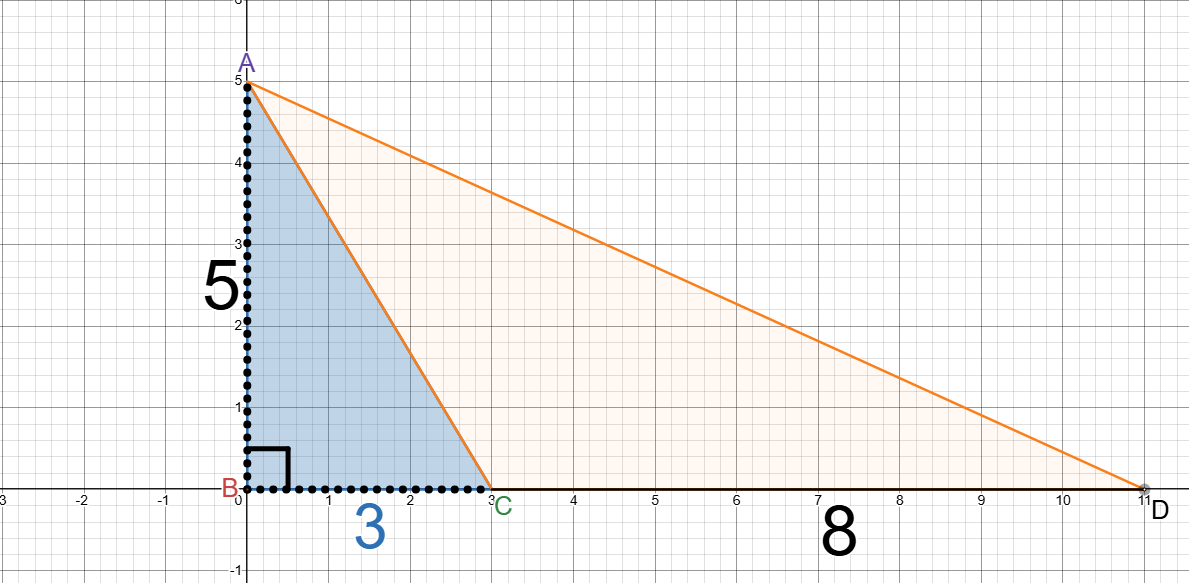
Yes. So the area, 20 will not be for ABD but for ACD.
Like you correctly noted, if the base BD had been known, then we could find the area of ABD.
Yes.
I know it is unintuitive but that is how it works (hopefully, the screenshot below helps you see it).
Yes and no.
Yes because I see the point you are making - that we can’t have a perp directly from A touch CD and be 90 at once.
No because, that is what we have done in this diagram right now, at least mathematically. The perp might not be directly touching CD but for the case of the area of a triangle, what we have here now in the diagram is somewhat equivalent to dropping a perp from directly from A to the base CD.
Again, it is not intuitive at first exposure but that is the beauty of it - it works.
Yes and that is what we are most used to, but that is not the only way to find the area.
The perp can be outside the triangle like in this diagram.
In that case, AD becomes the base while the perp drops from C to AD.
Remember that, the base and heights are not fixed elements of a triangle because depending on how you rotate the triangle, any of the 3 sides of the triangle can become the base, upon which we can erect the corresponding perpendicular height.