Bigbook Test 16 Section 5 (Question 20)

I want to confirm whether my approach is correct or not for this question.
Since PRS is an equilateral triangle if we try to find the area of all the small triangles present inside it (including shaded ones) they would be equal. So, they are all symmetrical. As a result,
ratio would be=
2.1/6.√3/4. y^2(multiplying this by 2 because there are two shaded triangles) (assuming y to be the side of the triangle)
(÷)
2.√3/4.y^2

After simplification we get, 1/6

Is that the correct way to go about this?

I don’t see the need of \frac{\sqrt{3}}{4}. As far as I can see, it’s just \frac{1}{3} \times \frac{1}{2} = \frac{1}{6}.

Is my logic correct though? The way I arrived at the last step? Does the symmetry of triangles only happen in equilateral triangles?

Your logic looks right to me.

You’re trying to figure out \frac{area\ of\ shaded\ area}{area\ of\ entire\ area} = \frac{area\ of\ equilateral\ triangle\ \times \frac{1}{6} \times\ 2}{area\ of\ equilateral\ triangle\ \times\ 2}

Just in case this is helpful, here’s my way of solving it:

  1. Both triangle PQR and PRS are congruent.
  2. The six smaller triangles inside triangle PRS are congruent.
  3. So there are a total of 6 \times 2 = 12 smaller congruent triangles shared between the two triangles.
  4. Two of the smaller congruent triangles are shaded.
  5. So the fraction of PQRS that’s shaded is \frac{2}{12}, or after simplifying \frac{1}{6}.

What symmetry? The altitude is also the median in an equilateral triangle. Also as you might know, each median splits the area of a triangle in half and all three medians split the area of the triangle in 6 equal partitions.
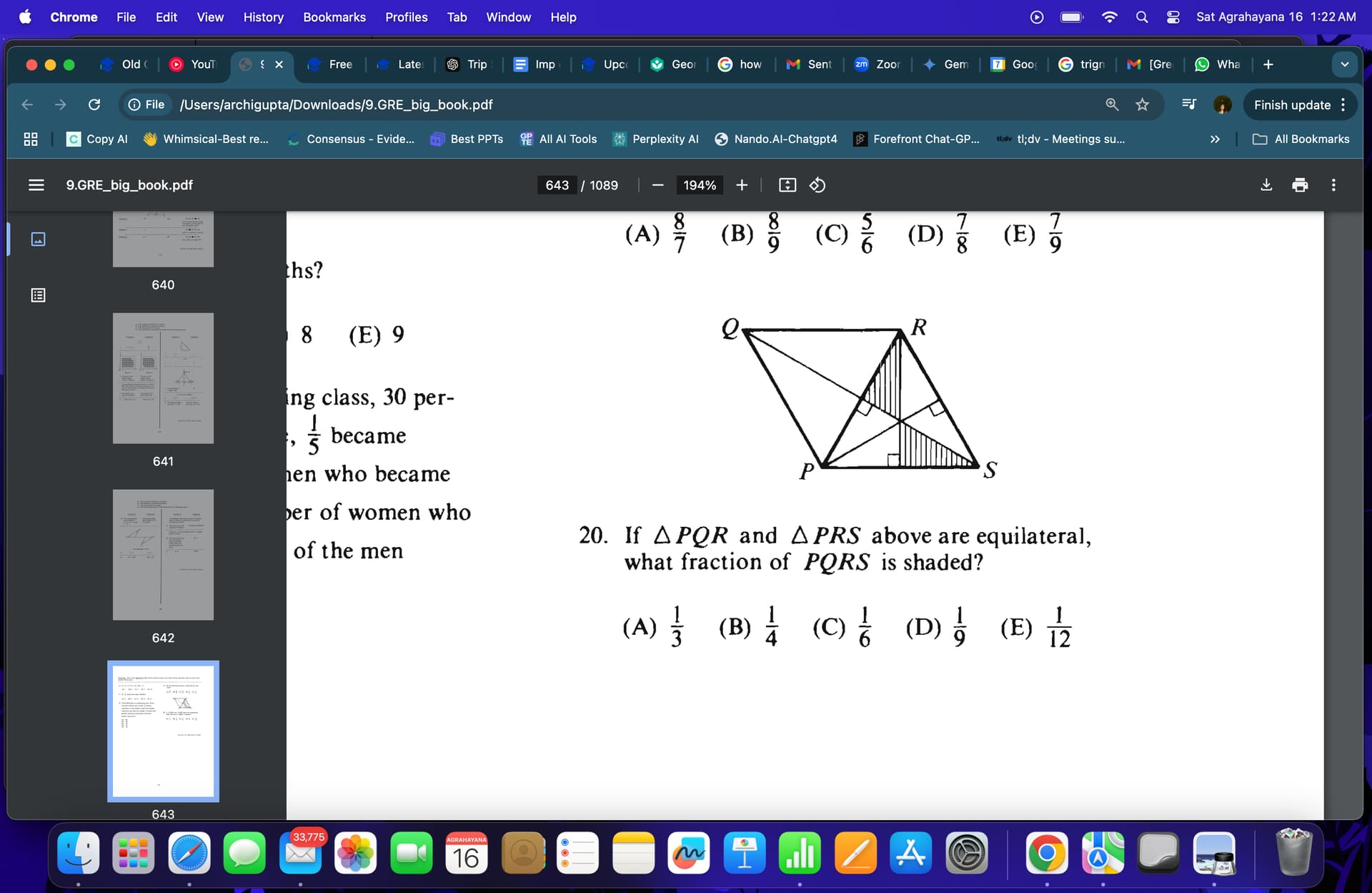
Thus it’s just 2/(6 + 6) = 1/6