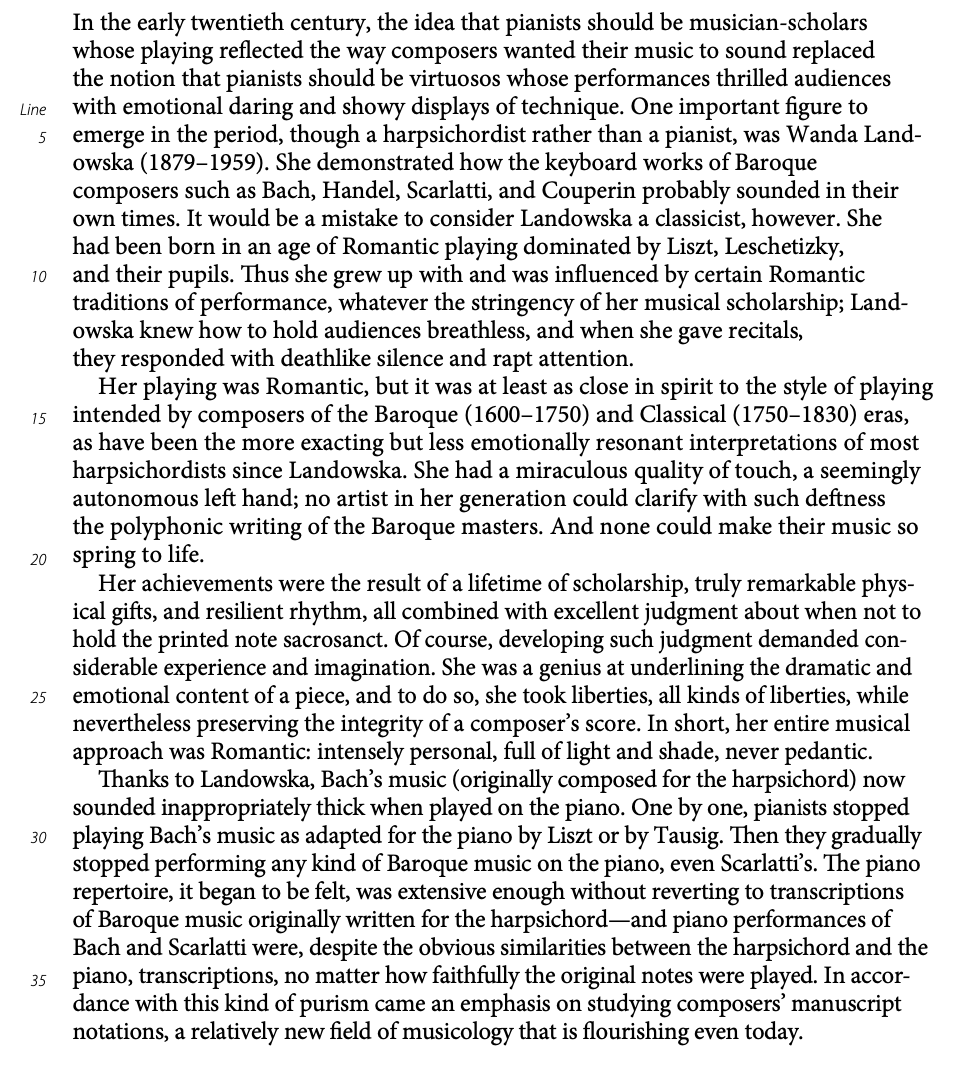

In this question, I thought that in line 28 where it says “Bach’s music (originally composed for the harpsichord)…” did not entail all of Bach’s music. Hence, when it said in option A, “a Bach keyboard piece” I thought that it was a piece that was originally intended for the keyboard. Where did I go wrong in arriving at that conclusion and how can I correct it in the future? Thanks!
Ideally, you would have predicted that the answer would have to do with playing a piece on the same instruments that a composer intended.
Then you could have narrowed your choices down to A and E, knowing only one of these can be correct.
Eliminating choice A is a little tricky, since at first glance keyboard could refer to either harpsichord or piano. This is technically outside knowledge, but a harpsichord is an instrument closely related to, but sonically distinct from, a piano. In other words, they both have keyboards but produce very different sounds.
Aside from using outside knowledge, you can infer that harpsichord is a keyboard instrument via the text:
One important figure to emerge in the period, though a harpsichordist rather than a pianist, was Wanda Landowska. She demonstrated how the keyboard works of Baroque composers….
In order to determine which type of keyboard the music is written for, we can finish the above sentence, as well as look to the other mention of keyboard in the passage:
She demonstrated how the keyboard works of Baroque composers…probably sounded in their own times.
Bach’s music (originally composed for the harpsichord) now sounded inappropriately thick when played on the piano.
We have two indications that these keyboard pieces were intended for harpsichord, since playing them on piano produced an inferior, or at least an ahistorical, sound.
Additionally, E specifies the sonata was originally written for piano, but played on a harpsichord. This tells us the intended instrument and the performance instrument are unequivocally different, which is exactly what Landowska advocated against.
Since choice E lacks any ambiguity about the instruments being different than the composer hoped, and choice A has no evidence to support such a deviation, we should choose choice E.