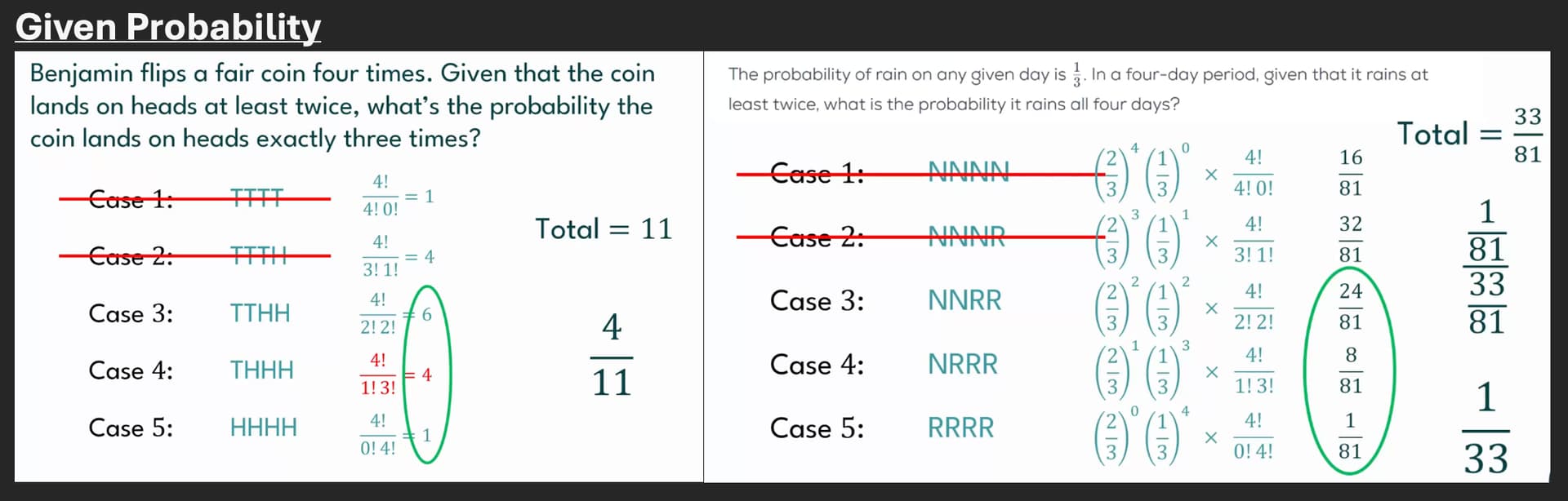
How come in the coin flip question we didn’t multiple the repeat by (1/2)^T and (1/2)^H like we did for the rain (1/3 and 2/3)? There was a similar question in tickbox quiz #15 and I got it wrong.
The naive definition of probability
P_{\text{naive}} = \frac{\text{number of favorable outcomes to some event}}{\text{total number of outcomes in the sample space}}
only works if every outcome in the sample space is equiprobable.
In the first question, this happens to be the case. Any specific sequence, such as HHHH or HTHT, has the same probability of \left( \frac 12\right)^4 of occurring.
However, for your second question, you can’t employ this method because different outcomes now have different probabilities. For example, the sequence RRNR has a probability of \left( \frac 13\right)^{3} \left( \frac 23\right) , which is different from the probability of an outcome like RRNN, whose corresponding probability is \left(\frac 13 \right)^2 \left(\frac 23 \right)^2.
Ahh okay! So, if it’s equiprobable it’s safe to “ignore” the individual probabilities?
Sure