Is it always the case

It was explained that this is Euclid’s proof. Is it true that if I multiply any three numbers together and add a “1” to it, I create a prime number?

Need more clarity on this (I must be missing an important critieria). I tried a few numbers and it worked, but I tried (9 x 5 x 2) + 1 and it gave me 91 which is not a prime number
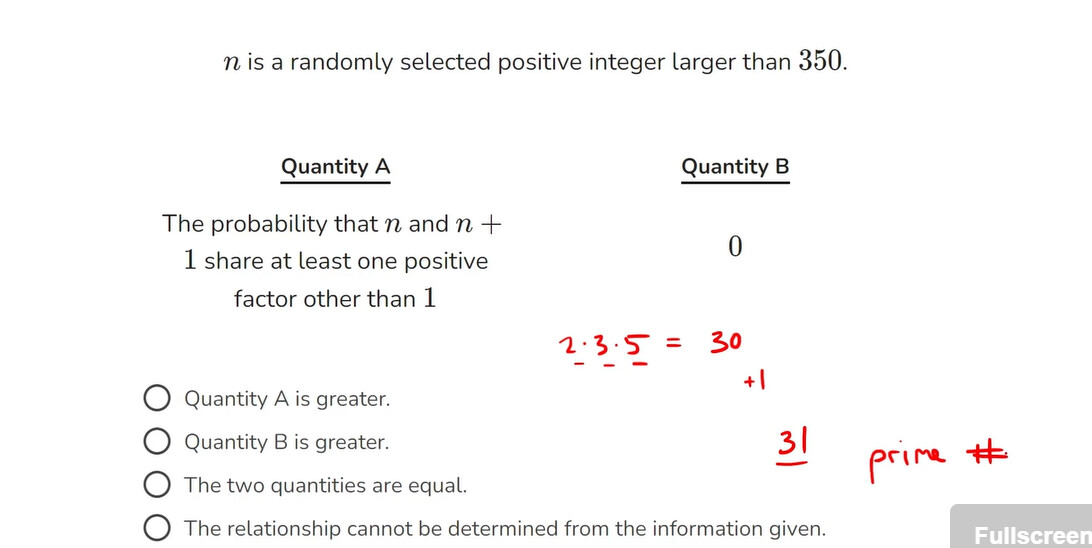
I think this is testing a different concept.

  • Can two multiples of 2 be next to each other? No, they must be at least 2 apart
  • Can two multiples of 3 be next to each other? No, they must be at least 3 apart
  • Can two multiples of 4 be next to each other? No, they must be at least 4 apart
  • Can two multiples of 5 be next to each other? No, they must be at least 5 apart
  • And so on…

So two adjacent/consecutive integers can’t share any factors except 1