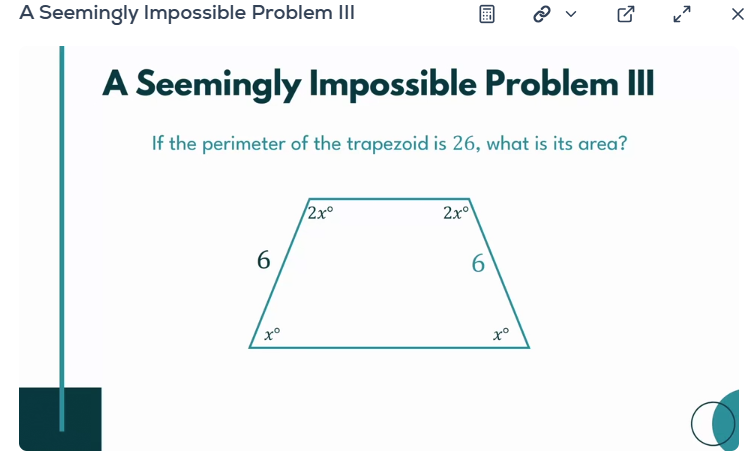
The angles match up because the labelled internal angles dictate it.
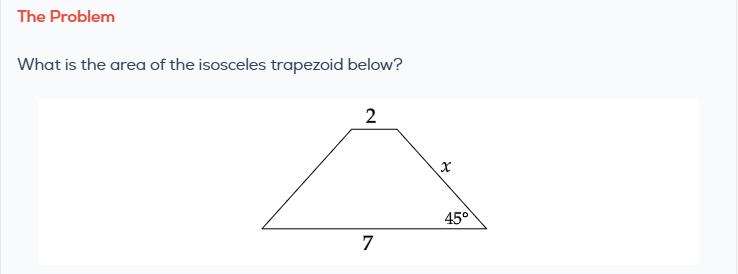
I don’t think a new video is needed for ‘‘isosceles trapezoid’’, however, the video or question could benefit from explaining what an isosceles trapezoid means. @Leaderboard
@Kweku What exactly does this mean? Did a previous lesson already show what relationship angles x and 2x have in a trapezoid, when the sides are equal? If not, then how is one supposed to arrive at that conclusion?
Perhaps consider for a second that not everyone taking the course might be an advanced math test taker already?
After finding x=60°, drop a perpendicular height from the vertices with 120°. You create triangles 1 and 3 and a rectangle in the middle. Triangles 1 and 3 are congruent because both are 30-60-90 triangles with the same height which means their hypotenuse is also the same value of 6.