the question ask must → so we have to check for all the cases
The question asks which is the largest number that must be a factor of n.
Since you have reduced the possibility to 6 and 12, now you need to find an edge case that invalidates one of the answer. So if you find a number that has a factor of 6 but not 12, then 6 is the answer. If you can not find such numbers, meaning every time you have a number with factor 6 it also has factor 12 then the answer will be 12.
Let’s try numbers. Of course the easiest will be: n=6
When n is 6, n^3 = 216 which is a factor of 24 as 24*9 = 216.
However, it is obvious that the number 6 can not have a factor greater than 6. Therefore, the number 12 is not always a factor of n. This leaves you with answer 6
First I evaluate n^3 is divisible by 24, where n is an interger
24 is 2^3 * 3^1
I set n^3 >= 24
Notice that for n to be an integer, n^3 prime factors must all be more than or equal to 3. Thus, n^3 >= 2^3 * 3^3 for n to be an integer
The question asks for largest possible value, therefore I want to look for the smallest number n could be which is 2 * 3 = 6, thus the largest factor possible answer is 6 and not 12.
What do you mean by the substitution method ?
I know one in which we can prime factorize and then solve, let me know If you’re unfamiliar with that approach.
Can you please provide your approach?
Sure!
So we’d take the number : 24 and break it into primes - 2x2x2x3.
We have three 2’s and one 3 in 24.
Now, since the question says n cubed is divisible by 24 and is asking for ‘must be divisible’ of n,
we can safety say that n must have one 2 (as when this n will be cubed, we’ll get 2x2x2).
However, to get one 3’s in a cube we will have to take one 3 [can’t take less than this] (one 3 —> cubed ----> 3x3x3, still satisfying the condition n cubed to divisible by 24)
So, one 2 and one 3 for n, thus answer 2x3 = 6.
Additionally,
say of the number was 216 -----> primes ------> 2x2x2x3x3x3 i.e. three 2’s and three 3’s.
then if n has one 2 and one 3,n cubed will certainly have three 2 and three 3 thus n would again be 6.
Say if questions was. n squared was divisible by 72----> Primes ----> 2x2x2x3x3 and asked for n -
If we take one 2, squaring will give us two 2’s, which is not sufficient (need three 2’s), but if we two 2’s, this will be enough (squaring would give four 2’s). But we can take one 3 (squaring will give two 3s, sufficient) Answer - 2x2x3 = 12.
This was more twisted to explain that I though, hope this is clear : )
\m/
1 Like
Hello , thanks for the solution.
This was a little difficult to understand though. Not able to visualise this particular concept directly in my head.
Is it possible to approach this question algebraically?
I guess everything has an algebra way, in this case, it might be even more non-intuitive than this.
Give this a try with a calm mind, or maybe write it down 
Once you get it, you’ll find it obvious.
If I give you the number n cubed and say it is divisible by 64, and I ask you what will be the largest factor of n?
1? 2? Sure! … Largest? Nope.
What about 4?
If n=4, then n cubed is 64.
64 is divisible by 64, works! and largest factor of n is 4. (4/4 = 1) [answer]
What if the problem was, n3 is divisible by 256, what is the largest factor of n?
What this means is, n3 = 256 x something
or
n3 = (4x4x4x4) x something
The questions asks about n.
So, if we say that ‘n’ in its composition (factorization) contains only one 4. THEN,
n = 4x(something)
n3 = 4x4x4(something x something x something)
Now this ‘something’ could be 4, but it may not be. And the questions asks ‘must’.
So, this is not sufficient. ( We saw that n3 must have four 4s)
Let’s try,
n = 4x4x(something)
n3 = 4x4x4x4x4x4(something x something x something )
Again, ‘something’ could be 4, but may not be. However, we needed four 4s and we have ensured it. We don’t care about this something now.
Hence, n = 16 * Something.
Greatest factor (must) = 16
(something could be = 2, then the answer may be 32, but again, it could be 1, so for ‘must’ … answer = 16)
If you get this, you’ll get the question.
1 Like
Thanks for the detailed explanation. This will help
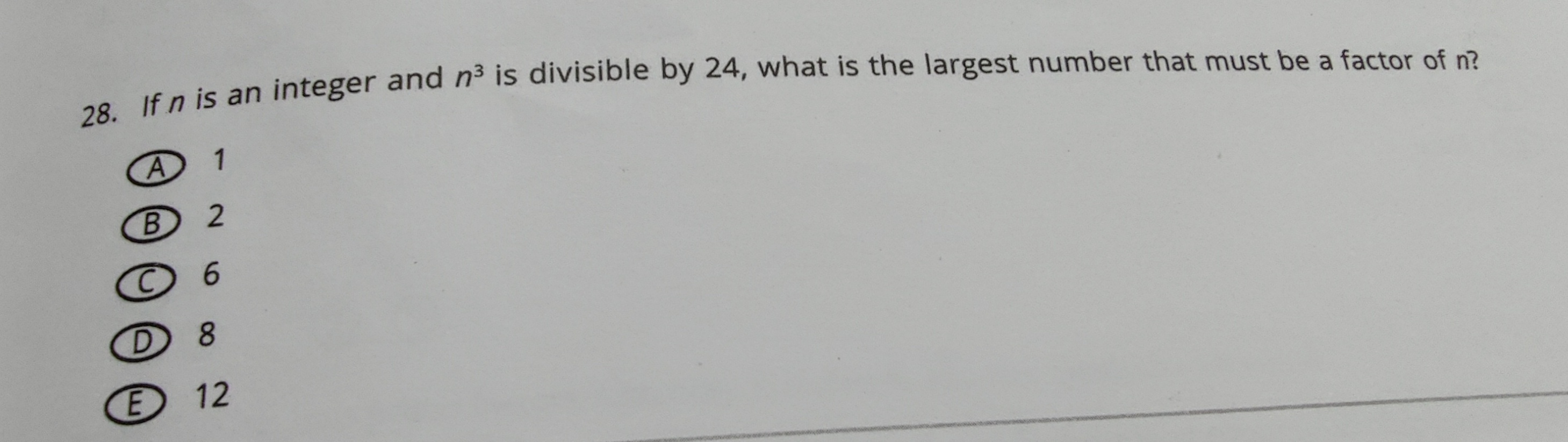
If n is an integer and n^3 is divisible by 24, what is the largest number that must be a factor of n?
(A) 1
(B) 2
(C) 6
(D) 8
(E) 12
Since they wanted the largest number that must be a factor of n, they haven’t mentioned that n should be the minimum or least number. n could be 6 or 12. and answer is 6. but 12 also follows the conditions.
12^3=1728 and that is divisible by 24 So,12 could the largest factor?!
My question is why is it 6, since they haven’t mentioned n should be min or max !
Thank you!
I guess 12 was ETS’s trap, in case people plugged in the answer choices.
Here’s my approach to this problem:
First off, factoring 12 we get 2^(3)×3^(1)
Now, for every prime factor n has, n^(3) must have three of them.
Thus, n^(3) must have prime factors in triplets, so if 3 is a factor of n^(3), then n^(3) must have three 3s atleast. [Note that n is an integer, so without 3’s power being a multiple of three, n can’t be an integer]
So, if n^(3) is divisible by three 2’s and three 3’s, n must contain at least one 2 and one 3, or 2×3=6.
Thus, the question says what is the largest integer that must be a factor on n. 12 could be a factor, but 6 must be
If n is an integer and n cube is divisible by 24, what is the largest number that must be a factor of n? options are 1,2,6,8 and 12. The correct ans is 6. Thanks
\left(\frac{n^3}{24}\right)^{1/3}=\frac{n}{\sqrt[3]{2^3\times3^1}},\text{Now, to make denominator an integer we need to add two more 3's }
\frac{n}{\sqrt[3]{2^3\times3^3}}=\frac{n}{2\times3}
\frac{n}{6},\text{the largest factor of 6 is 6}
Thanks a lot. why did you do 1/3 in the first step? Like how did you know we need to multiply by exponent 1/3 in this question?
because we were given the relationship about cube of n and we wanted to find n, thus I took the cuberoot of the whole equation.
1 Like
it really took hell a lot of time to rule that 12 out from my answer 