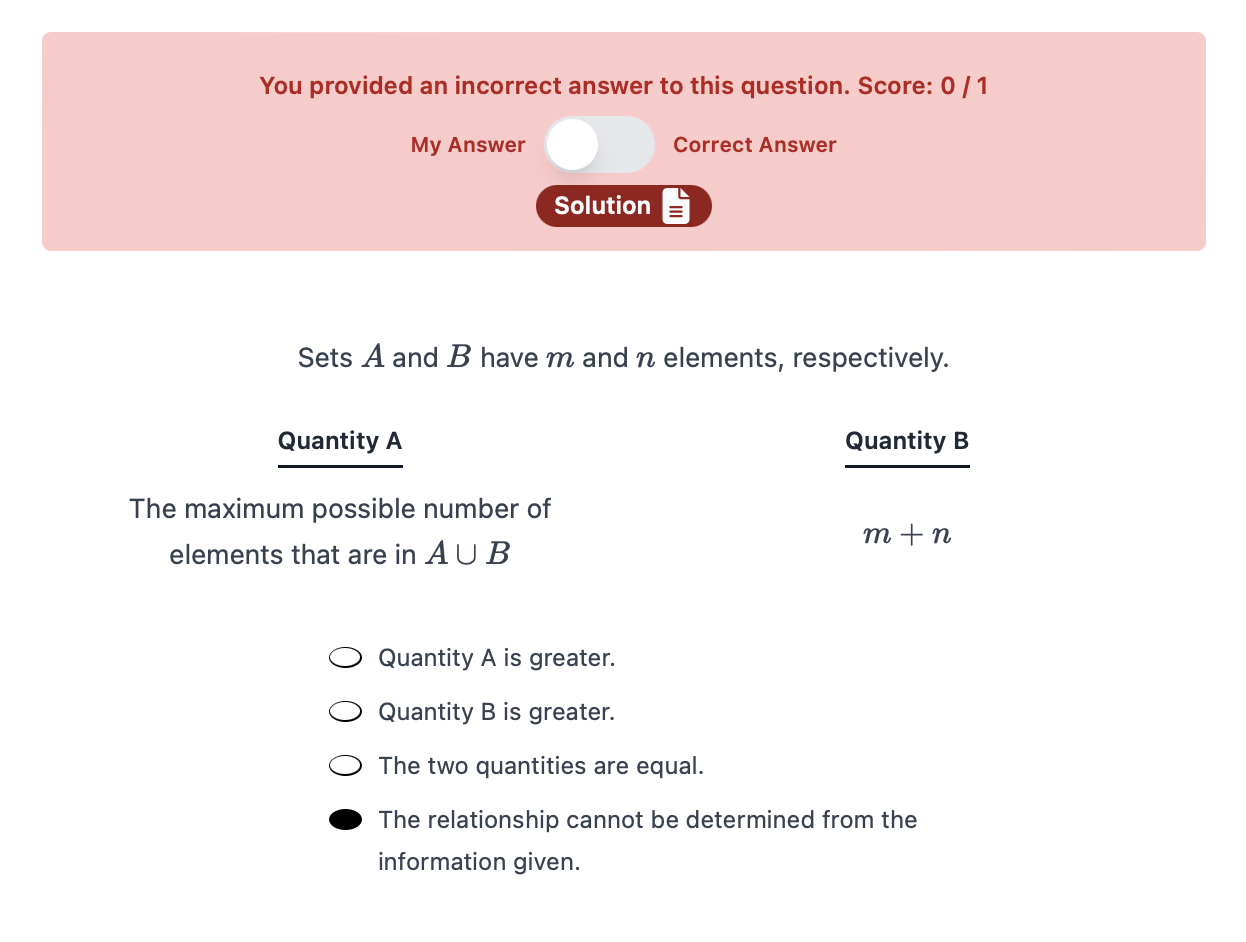
I’m not sure I understand the solution path here (the quantities are equal).
Say, set m and n each have 4 elements.
So, the best case scenario is that both sets have distinct values, which makes the maximum possible elements 8 which equals m+n → the quantities are equal.
If the sets share values ( A (1,2,3,4); B (1,2,5,6), however, the maximum possible amount will be smaller than adding the total elements of both sets. e.g. 6 non-repeating values as maximum possible values vs. 8 (m+n) → Quantity B is greater?
Yes, the maximum possible number of elements in the union occurs when A and B are disjoint.
“The maximum possible amount” doesn’t make sense here because there’s only one number corresponding to the number of elements in the union in your example. By “maximum” they’re referring to all possibilities of set A and set B and then picking which gives you the “highest” value for the union.
Tldr,
|A \cup B| = |A| + |B| - |A \cap B|
The union is maximized when the intersection is 0, and so the maximum value of the union is m + n.