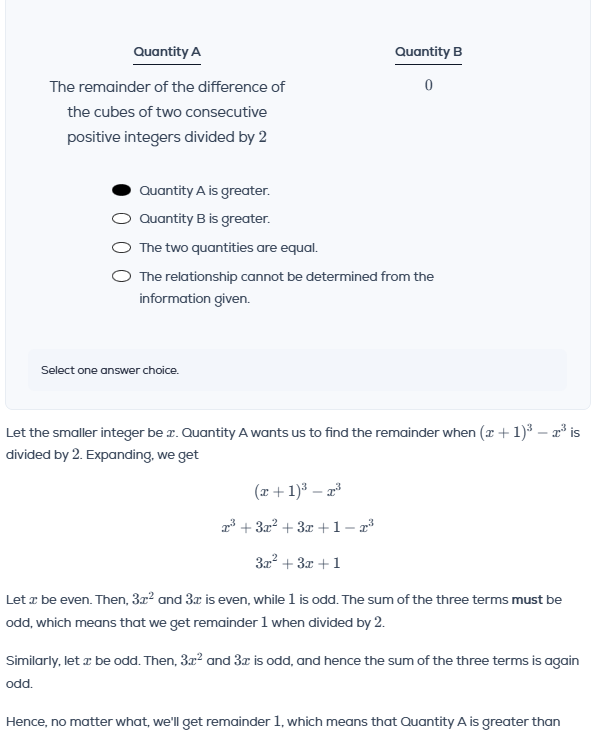
In this question, we are to find the remainder of the difference of the cubes of two consecutive positive integers divided by 2. The answer rightfully points out that remainder of one of the terms will be 0 and the other will be 1. Therefore, when we take a difference between the two, it can be either 1 or -1, right? Therefore, we can conclude that we do not known whether the result will be greater than or lesser than 0.
Hence, a -1 Remainder will have to be converted to its nonnegative complement by adding the divisor, 2 in this instance to -1.
Final Remainder is therefore 1.
More on the negative Remainder complement:
-29 divided by 5 leaves -4 Remainder, whose nonnegative complement is +1 (the correct Remainder).
Use this approach as a shortcut for remainders specifically, as it leads to the wrong quotient.
-29 divided by 5 has a quotient of -6, not -5.
***Note that when I use “remainder” together with a negative number, it is strictly incorrect, since remainders are nonnegative. I maintain the terminology here strictly for the purposes of illustrating the shortcut.
In this case, I have assumed the remainder to be positive only. So either 0 or +1. But whether the first no.'s remainder is 0 or +1 depends on whether the first no. is odd or even.
If the first no. is odd, the sequence of the remainders would be +1 and 0, but if the first no. is even, the sequence of remainders would be 0 and +1. In the case of the former , the difference between the remainders would be -1 and in the case of the latter it will be +1…