I’m having a hard time understanding what Greg is saying here.
I understand that there are two equations: x^2 + 9x -d and x^2 +9x + d
And using the discriminant, shouldn’t the one for x^2 +9x -d be 81+ 4d since d is negative here? Greg says otherwise here.
And also, if the answer is truly -20.25, how can I use that in x^2 + 9x -20.25 to prove that its right? What would x be in this case?
If we re-arrange the equation and move the d, we can get |x^2+9x|=-d. Since absolute values must be non-negative, this means that d itself must be negative, so the RHS is positive.
If we want 3 solutions exactly, we need one disc to equal 0 (1 solution) and another one to be more than 0 (2 solutions).
Since we know that d must be negative, it can only be the 81 + 4d that can EQUAL 0, because the other one would end up being bigger than 81
Alternatively, if you’re interested in solving this one with coordinate geometry rather than algebra, its covered at around 6 mins in this video:
I see. I kind of understand now. But I’m curious how do you get the two equations of 81 + 4d and 81 - 4d?
For example, we have two equations : x^2 + 9x - d and x^2 + 9x + d
I’m curious why the discriminant equation is 81 + 4d for x^2 +9x + d because if d has to be negative, then the discriminant will be 81-4(-) so it’ll be greater than 0 not equal to 0.
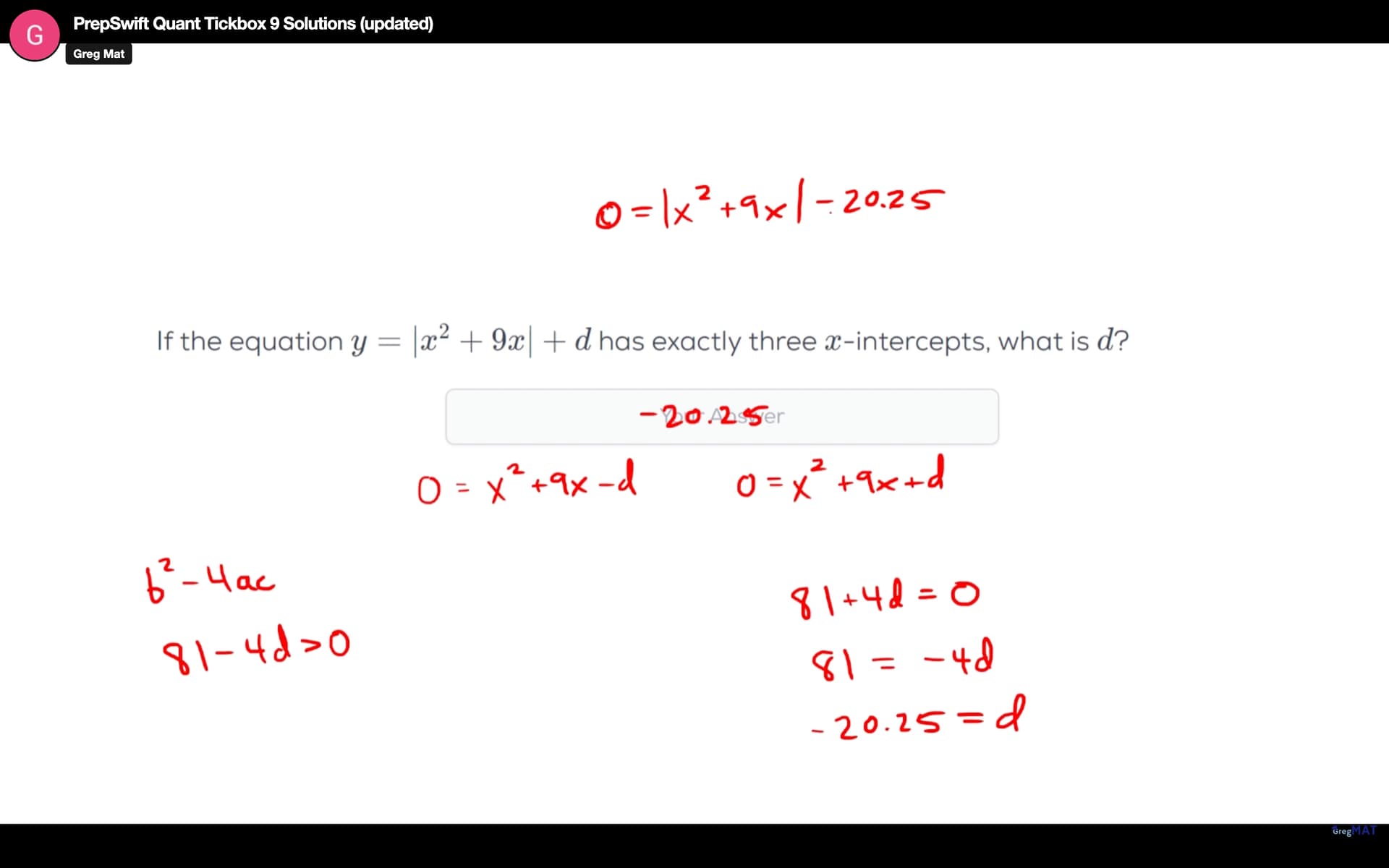
 Any help would be appreciated!