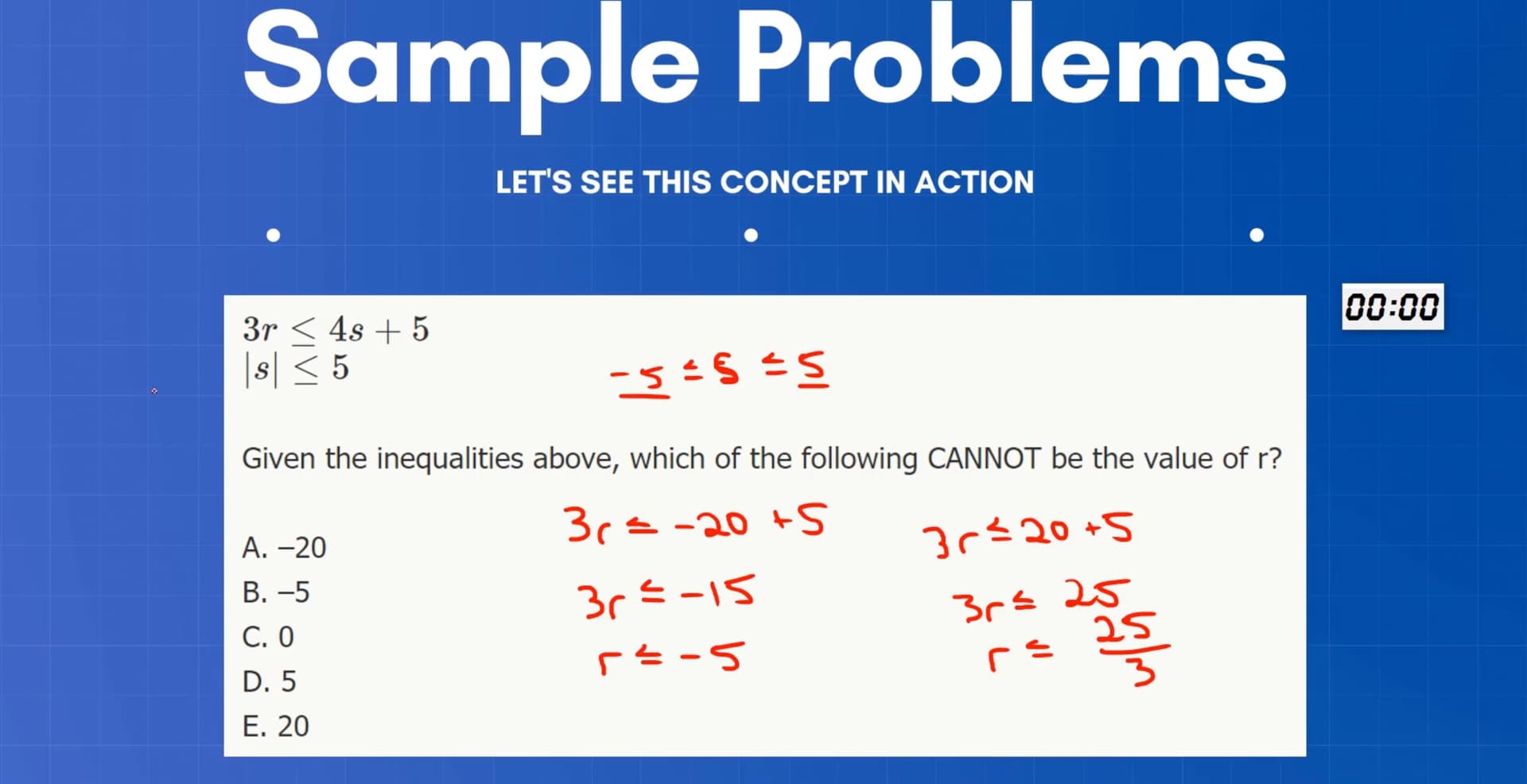
Wouldn’t the answer include 0, 5 and 20 because of r<=-5? Why is it only E.
Greg mentions “overlap”, which I did not understand. ChatGPT says the answer is A for some reason.
Thanks in advance for the help.
Video is Real Numbers and Absolute Value Practice. About 30 mins in.
Here, I believe the point is when we split into two inequalities, we get r\leq -5ORr \leq23/5
If you plug in r=0, (when it only satisfies r \leq23/5 but not r\leq -5), it still satisfies 3r\leq4s+5 because s can be 5.
Because this is not a system of inequalities, and as long as r satisfies the first inequality when any s that satisfies the second inequality, then the r value is valid. So same holds for answers 5 and 20.