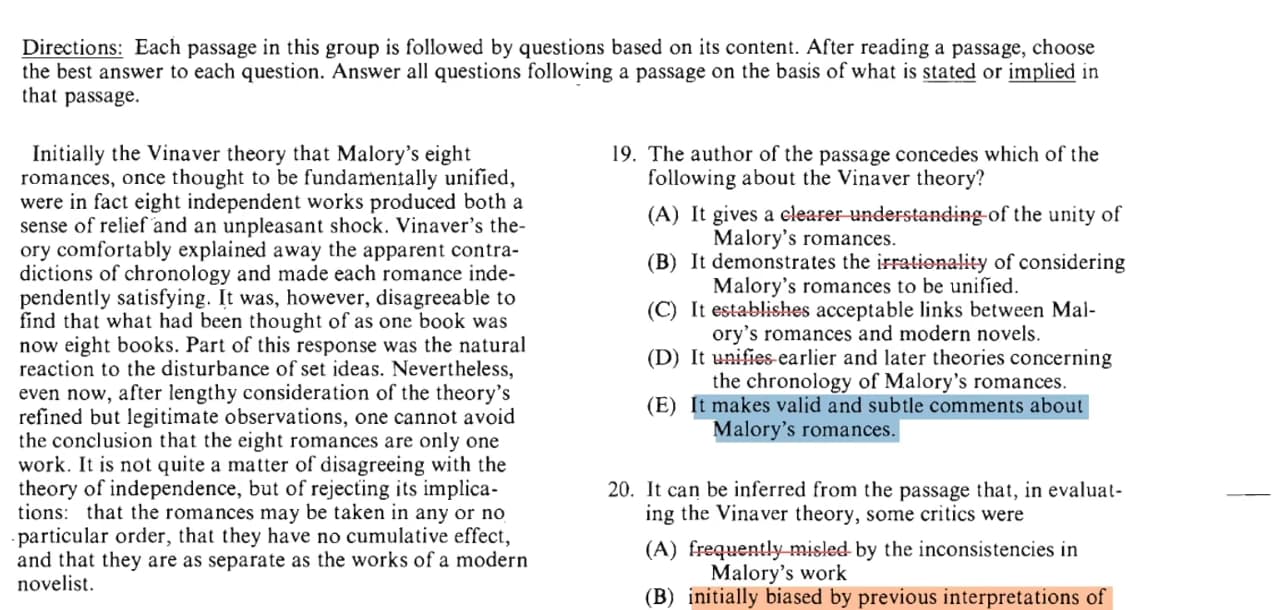
This is from the last passage from the (2024 Edition with ETS Material) GRE Reading Practice Session 2 video. For question 19, I initially selected B and ruled out E because I missed the connection between “subtle” and “refined”. You can see from the screenshot above that Greg ruled out B based on the word “irrational”. However, the Author says “Vinaver’s theory comfortably explained away the apparent contradictions of chronology…” I used block of 4 in this case to reach the following conclusion. Vinaver explains the contradictions of time, critics disagree with Vinaver therefore critics disagree there is a contradiction of time. If the contradictions are “apparent” then why can’t we say the critics are “irrational”. This if further supported by the fact that the author later says critics’ responses are “natural reaction to disturbance of set ideas” meaning they are biased. If they are biased then this supports the idea of them being “irrational”. Personally, I think this is a flawed question because I am not convinced we can rule out “irrational”; which is demonstrated by the fact that only 25% got the right answer from the Big Book answer key. That said, I would appreciate any constructive criticism on things I may have missed or misinterpreted.
We can play a game here: we know choice B is wrong. What would the text look like if it were right? There would have to be something in the text where the author connects the idea of unification being irrational in a concession. We can’t point to anything that does that.
Part of your problem here is what I call location. If you’re not looking at the sentence in which the author concedes something, the question is much harder.
There aren’t any flawed questions from ETS - that is a dangerous belief. We must learn from all questions about how the real test behaves.
Appreciate the response. If we play your game, I would argue “Vinaver’s theory comfortably explained away the apparent contradictions of chronology and made each romance independently satisfying” is a concession. The reason being that V explains the contradiction and made each romance more satisfying, so the Author is acknowledging the merits of this theory. I’m curious why this wouldn’t be a concession. This is further supported by the later quote “refined but legitimate observation”. Here we can use the previously mentioned strategy because the only legitimate observation of V that the author referenced prior to this sentence was the “contradictions of chronology”.
The reason why I say this question is flawed is because this is a function question, not an inference question which means the incorrect answer must be 100% wrong. If it was an inference question, I would say E is 100% correct and B is 60% so E is the better answer. However, in a function question, the wrong answer must be 100% wrong, either contradicts or no evidence. If you think we can 100% say B is wrong and the evidence I presented in the first paragraph is incorrect I’d love to hear why.
not a concession. A concession is part of an author’s opinion, whereas in the beginning of this and most passages, the author here is not giving his / her opinion, but instead just filling us in on the background of the topic.
This is not a function question. There is no “best answer” on the GRE. All answers are either wrong or right (keep in mind, a word or two can make a choice wrong).
B is wrong for multiple reasons. No concession. No support for “irrational” (having chronology contradictions doesn’t necessarily = irrational).
I can see how it’s not a concession now. I initially read “produced both a sense of relief and an unpleasant shock” as the Author’s opinion, not observation. I would categorize this question as a function because it’s asking why the Author is conceding i.e. what the Author is doing. Also the answer choices all contain verbs. Curious how you would categorize this question?
The question is not asking why the author does something… also you might want to review function questions - too much to discuss in a comment.
This is just a normal detail question.
Got it, appreciate the response.