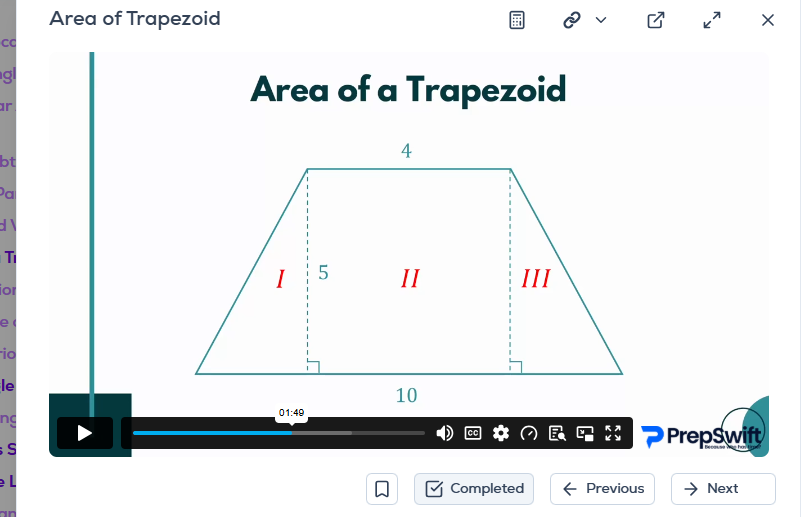
How did we divide the remaining of the bottom base (10 above)
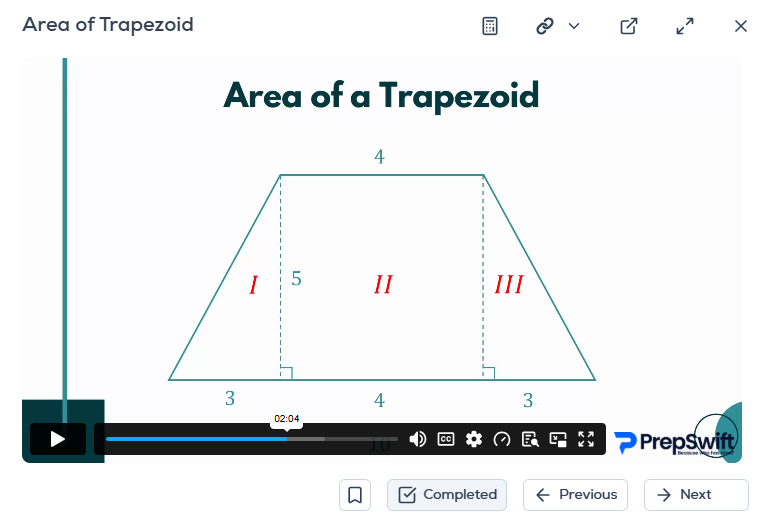
into 2 equal sides/bases of 3 for the two triangles I and III?
The video just says 10-4 = 6 and 6 divided by 2 = 3 for each of the 2 triangles.
It is an isosceles trapezium where triangle I and triangle III are congruent.
G is illustrating why the formula works that’s why he used that.
Another way to see it: Imagine flipping triangle I 180° (3-Dimensionally) about its base (using its base as a hinge) and joining it to triangle III by the hypotenuse. Basically, reorient trianlge I such that we can join it to triangle III by the hypotenuse. We form a rectangle with base 7 and height 5 which clearly gives area as 35.
@Kweku How did we conclude that triangles 1 and 3 are congruent?
For illustration purposes, Greg used two congruent right triangles, each with a base of 3 and a perpendicular height of 5, creating an isosceles trapezoid. The formula still works for trapezoids with non-congruent triangles 1 and 3. Congruence makes Greg’s visual demonstration easier to follow and explains why the formula works. Ex, the merger Greg creates with them to form the rectangle with area 15 would generally not work without congruency. Perhaps it would be beneficial to specify that the diagram used is an isosceles trapezoid. @Leaderboard
The formula indeed does work, but the method used for the proof does not work with non-isosceles triangles. Hence made a note on the video.