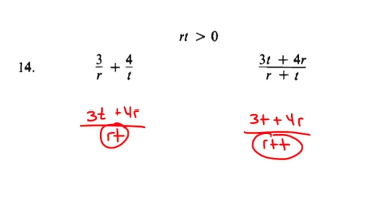
From this point, we can ignore the Numerator, we choose numbers for Denominator.
r=1, t=1 A is bigger
r= -1, t= -1 as per greg B is bigger. How? The left side will always be + as it’s 1/rt, and in this case Right side will be -ve.
What am I missing?
From this point, we can ignore the Numerator, we choose numbers for Denominator.
r=1, t=1 A is bigger
r= -1, t= -1 as per greg B is bigger. How? The left side will always be + as it’s 1/rt, and in this case Right side will be -ve.
What am I missing?
I don’t think you’re cancelling the numerator, are you? I think - correct me if I’m wrong - the comparison is made by substituting in both (3t + 4r) and (rt). In fact, you can’t just cancel (3t + 4r) because the inequality flips if (3t + 4r) is negative (which is the case when r = t = -1).
Yup I am cancelling the numerator, Considered them as same & crossed it so my comparison was in between 1/rt & 1/r+t
After watching greg’s solution, i realized I am doing something wrong, Maybe a foundational concept that I have missed? Could you elaborate more on ‘Equality flips’ . No matter what we do RT>0 Right?
There are two cases possible
In first case, if r=1 , t=1,A= 7 and B=7/2….A is bigger
In second case, if r=-1, t=-1 A=-7 and B =7/2….So B is bigger
So answer should be D
2 > 1
but -2 < -1 - notice that we are multiplying the previous equation by -1 on both sides.
Correct. However, in your method, you’re cancelling (3t + 4r) instead. That can be negative.