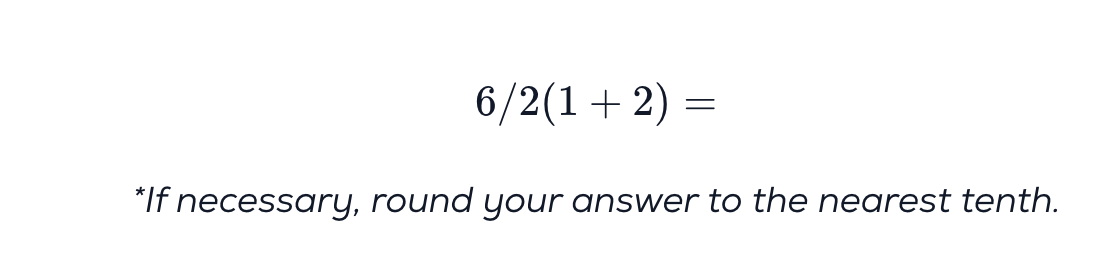
For this question, if it was instead 6 as the numerator and 2(1+2) as the denominator, would the answer then be 1? And so in this question, should we always read the / operation as a ÷ operator instead of indication of a fraction? Isn’t it somewhat ambiguous in this case, and couldn’t it either = 1 or 9?
Yes, it’s ambiguous because it boils down to which convention you’re following, or rather, how you interpret something like x/yz . If you go the order of operations route (BODMAS, PEMDAS, GEMA, or anything equivalent), then you unambiguously land at 9. On the contrary, if you consider a convention which says implied/implicit multiplication has higher precedence over explicit division, then you unambiguously land at 1.
In any case, I think you’re expected to follow the order of operations here.
Ok, so in similar cases on the GRE should I expect to follow the order of operations? Or is it unlikely I’d see something this ambiguous?
The questions on the actual exam are going to be unambiguous, so there won’t be any “similar cases.”
You should still keep the order of operations in mind so that you get the expected output from the GRE calculator.
Great, thank you!