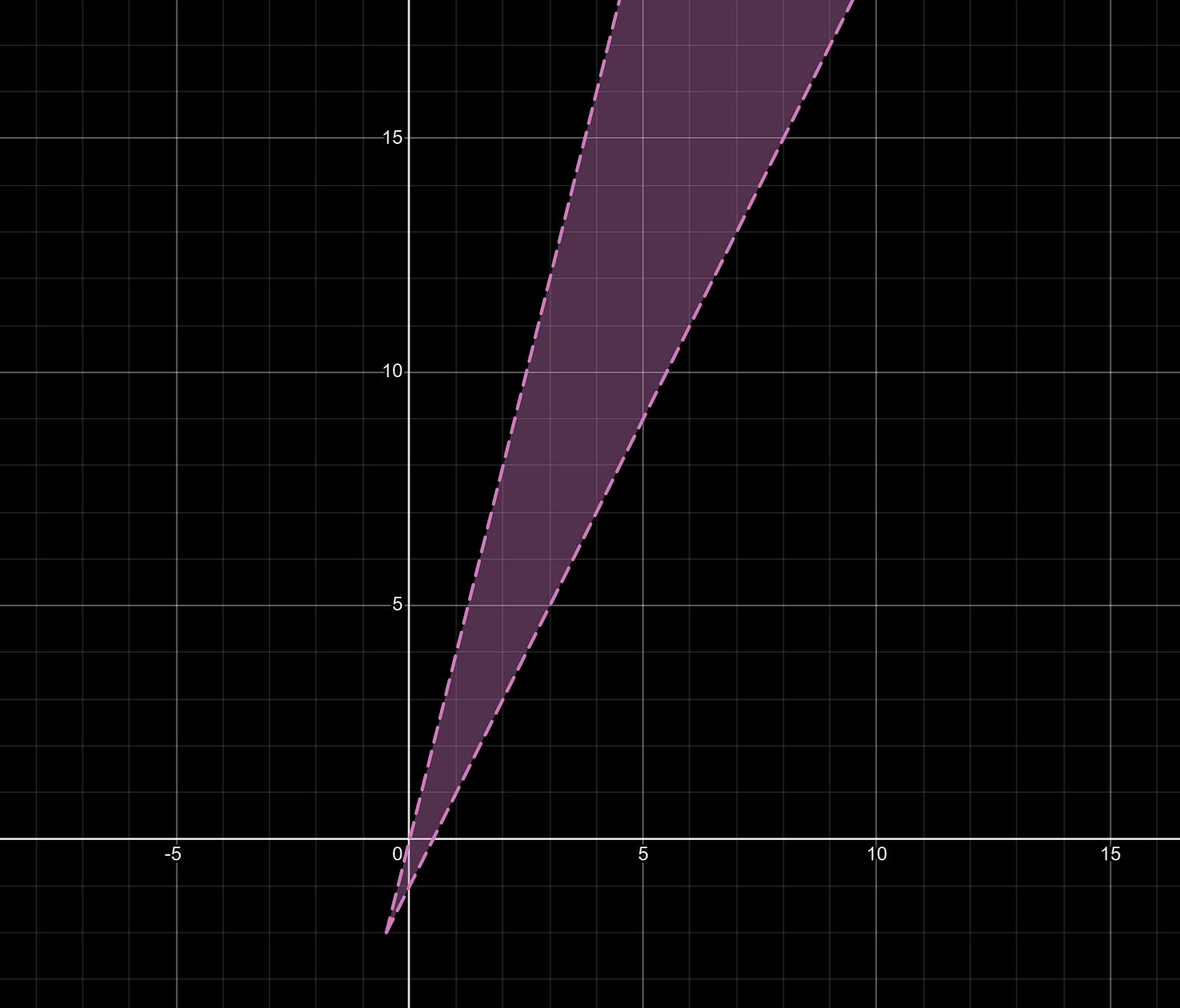
How to solve this via algebra?

OA = only C
y > 2x - 1 [1]
y < 4x [2]
Subtracting [2] from [1], we get x > -1/2
y > 2x - 1 (Multiply by -2)
=> 2y > 4x - 22y > 4x - 2 [3]
y < 4x [4]
Subtracting [4] from [3] we get y > -2
How to solve this via algebra?
y > 2x - 1 [1]
y < 4x [2]
Subtracting [2] from [1], we get x > -1/2
y > 2x - 1 (Multiply by -2)
=> 2y > 4x - 22y > 4x - 2 [3]
y < 4x [4]
Subtracting [4] from [3] we get y > -2
It’s all (x,y) such that 2x -1 < y < 4x
Can you help me understand what I did wrong? Was it not right to solve the inequalities separately?
You correctly established that all solutions satisfy x > -\frac 12 and y > -2, but that only helps you eliminate (-5,-5).
Essentially, all the points in this purple region are guaranteed to work.
So how do I eliminate A, B, and D using algebra?
Plugging numbers seems to be the easiest way but I wanted to know if algebra can help
There’s no ‘algebra’ here. We are simply asked to pick points (x,y) from the choices that satisfy 2x -1 < y < 4x. The only reasonable thing to do is to test out each of the options directly.
Rather than just being the “easiest” way, I would argue it is the only way. Perhaps, you could use the graphical representation I posted above, but that’s not fundamentally any different from just verifying each answer choice.