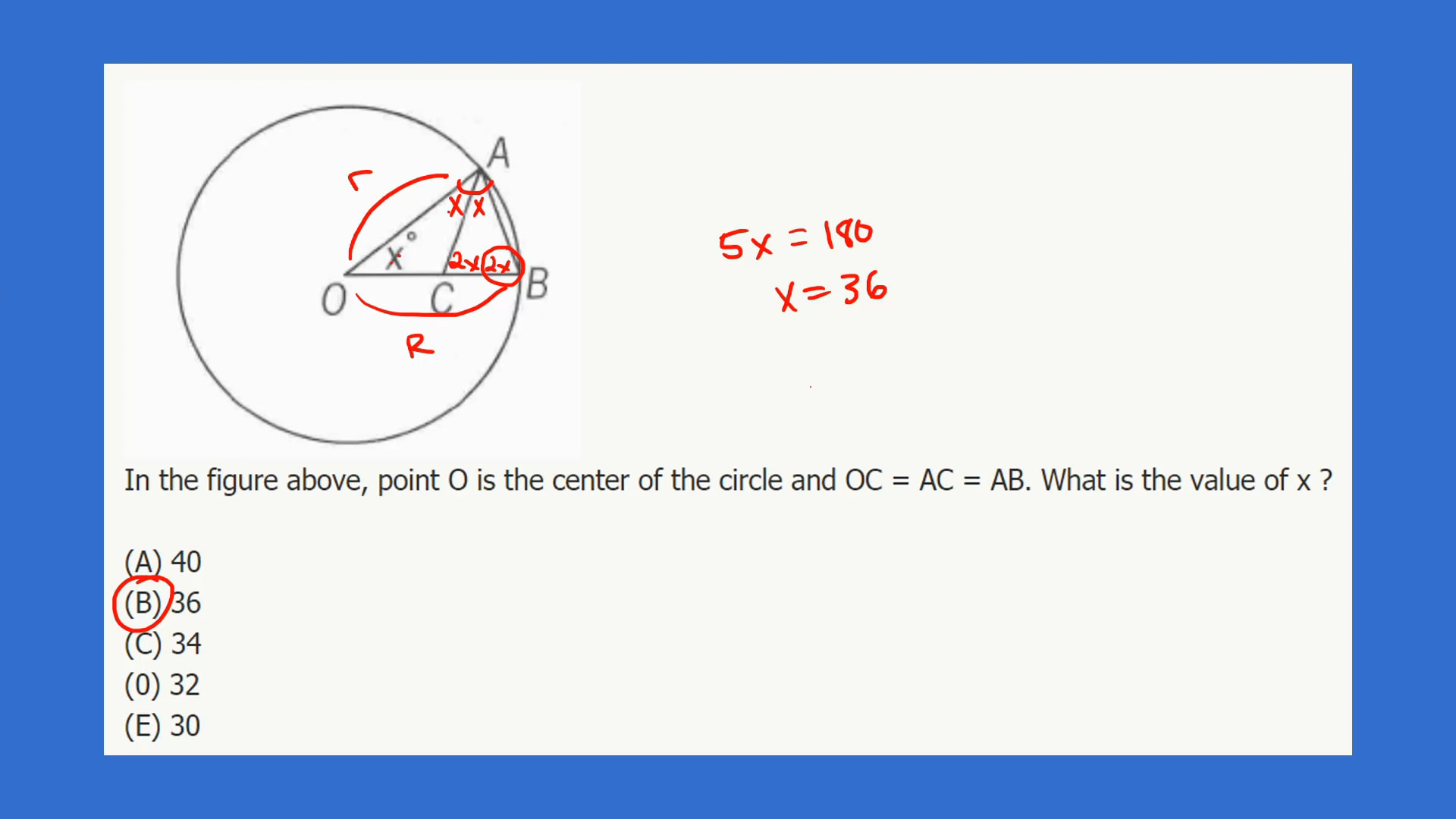
In this triangle, greg dervied angle C by using angle O, and mentioned an external triangle theorem that I can’t recall or find videos about
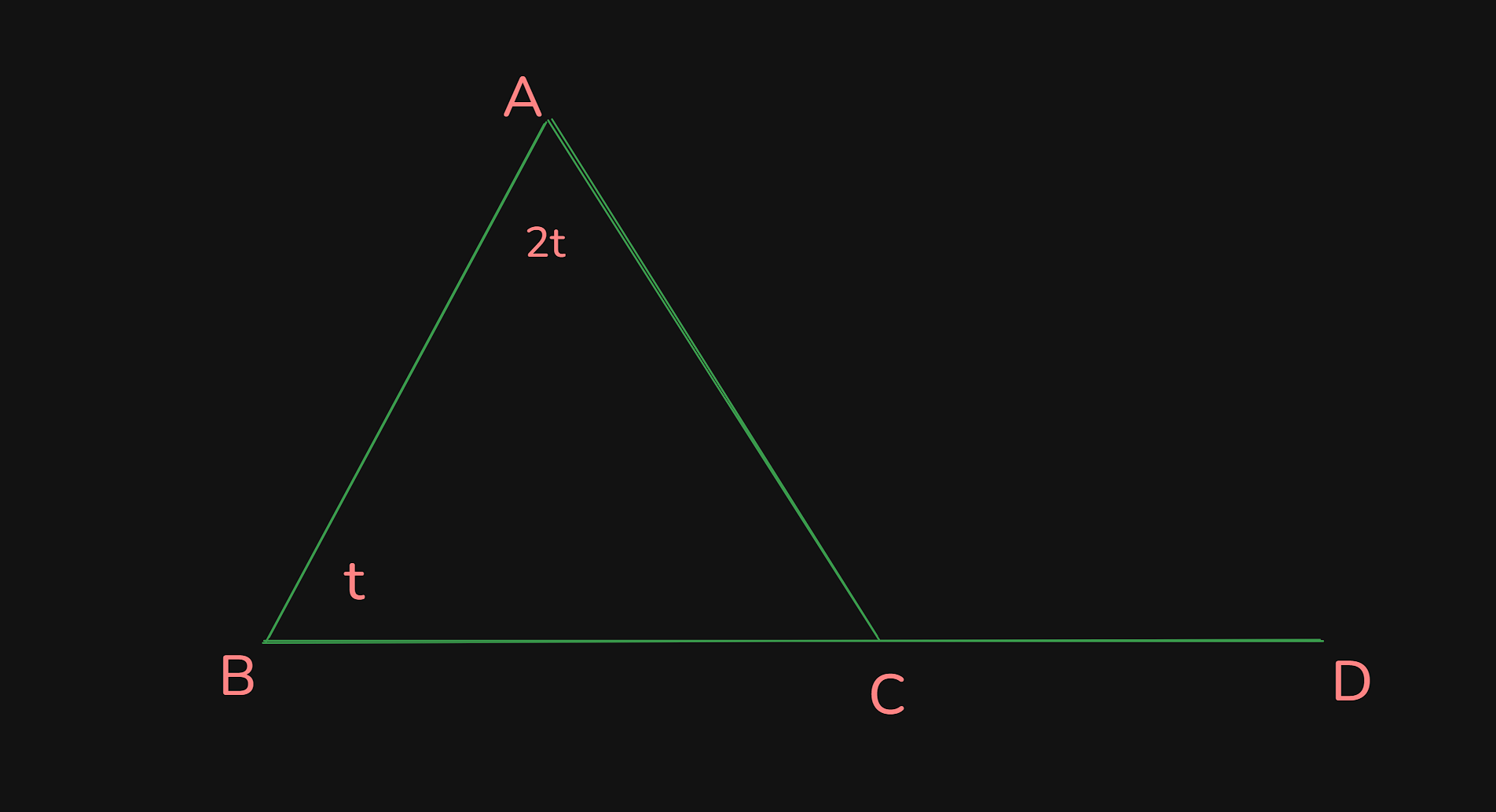
How would you find \angle ACD in terms of t, given that \angle ABC = t^{\circ} and \angle BAC = (2t)^{\circ}?
This is what i did please correct me if you spot wrong things.
I made 2 equations x = missing angle in BAC
t + 2t + x = 180
ACD = 180 - x
I move x over in the second equation to make ACD + x = 180
With the same sums, i equal the 2 equations to each other
ACD + x = t + 2t + x
x’s cancel out, which leaves ACD = t + 2t
Simplified ACD = 3t
OOOOH I SEE THE PATTERN.
So is it fine to assume, anytime there’s a triangle that has an extra line sticking out like that, it is assumed (without the closest angle given), that it is the sum of the other 2 angles further away?
So if i were to change your image that Angle B had 3t and Angle A 1000t, that Angle C would be 3 + 1000 = 1003?
Sure, that’s a good start.
You should’ve seen that the sum of the angles in the triangle gives us:
\angle ACB = 180^\circ - (\angle BAC + \angle ABC)
Since BCD is a straight line, the angles must add up to 180^\circ:
\angle BCA + \angle ACD = 180^\circ
So, we can solve for the exterior angle \angle ACD by substituting in our first equation:
\angle ACD = 180^\circ - \angle ACB
\angle ACD = 180^\circ - \big(180^\circ - (\angle BAC + \angle ABC)\big)
\boxed{\angle ACD = \angle BAC + \angle ABC}
As you can see, this is just a generalization of the exact steps you took to solve the problem above. It turns out that this theorem (the exterior angle theorem) is just a shortcut you could employ to arrive at the answer (conclusion) a bit faster.
1003t not 1003
1 Like