Tejas
February 3, 2026, 7:01pm
1
Hello everyone!
This is Q12 from PrepSwift Quant Tickbox Quiz #9 (Coordinate Geometry Column 3)
I tried to solve this sum using completing the square method.
So, step 1 is basically inside of the mod can be negative. Therefore 2 cases are possible.
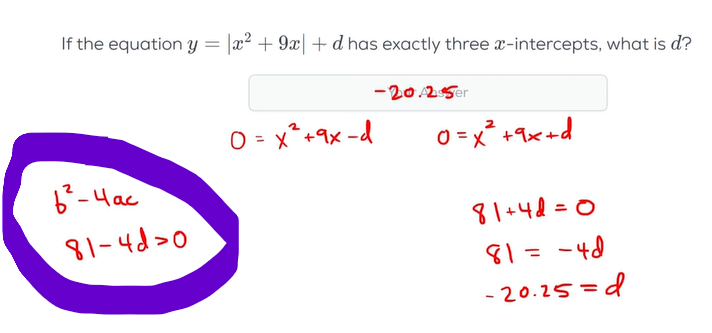
Case 1 is x^2+9x=-d
Case 2 is x^2+9x=d
So, if we do completing the square for case 1 we get new equation, (x+4.5)^2 -20.25=-d, so d=20.25
And if we do completing the square for case 2 we get new equation, (x+4.5)^2 – 20.25 =d, so d=-20.25
Now what should be my next step? In the video it said d cannot be a positive value as it doesn’t make the original quadratic equation 0
I have no idea how to procced ahead. Please help.
vince
February 3, 2026, 8:58pm
2
what’s the discriminant tell us about the number of solutions to a quadratic?
Tejas
February 4, 2026, 1:14pm
3
I couldn’t understand this step. I think this was too logical for me to handle.
Tejas
February 4, 2026, 1:15pm
4
I think I got it.
Step 1: Identify the inside expression. Since inside of the mod can be -ve it gives us 2 cases.
Step 2: Using the discriminant or completing the square find ‘d’.
Step 3: Note ‘d’ cannot be +ve. Why?
As |x^2+9x|=-d, where |x^2+9x| is >=0
Therefore, -d>=0, so, d<=0 So ‘d’ can either be 0 or -ve.
In our case we get two possible values for d, so d=20.25 or -20.25 therefore, d=-20.25, as d<=0
And we can substitute back ‘d’ into the 2 equations, which we get when the inside of the mod is -ve.
Case 1: y = x^2 + 9x - 20.25, has 2 solutions.
Case 2: y = -x^2 -9x – 20.25, has 1 solution.
Step 4: So now using the discriminant formula we can get the no. of solutions.
What do you think? Are there any gaps in my approach?
Tejas
February 4, 2026, 1:17pm
5
When I tried putting d=20.25 in the 2 cases. I was getting the equation equal to 0. I don’t know why. For me, the way mentioned in the video was overwhelming.
vince
February 4, 2026, 9:25pm
6
We just have to write the two equations, write out their discriminants, and then solve for d. No need to complete the square. Just keep in mind we can’t have a positive d because
∣x2+9x∣=−d
1 Like
Tejas
February 5, 2026, 8:42am
7
Just to clarify, I’ve made the discriminant=0, and then solved for d. I haven’t used any inequality sign as shown in the video, as it is quite confusing.
Since I’ve separately shown d<=0. It makes more sense to make discriminant=0, rather than making discriminant >=or<=
1 Like
I got 20.25 as the answer and when plugging it in it also comes out to exactly 3 x intercepts so im not sure why that answer is wrong. The two equations I wrote to solve the problem were:
x^2 + 9x +d and -x^2 - 9x +d
|x^2 + 9x| + 20.25 = 0 \iff |x^2+ 9x| = -20.25
Do you see the issue?
1 Like