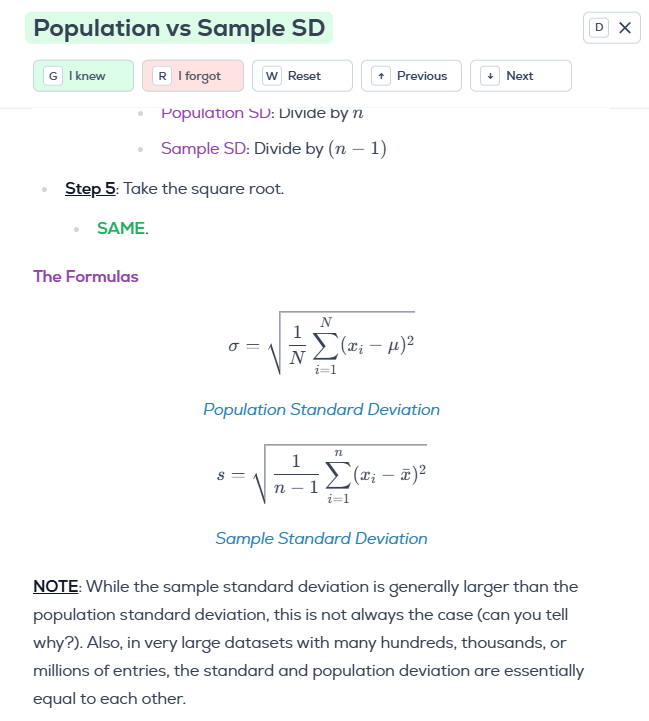
The population standard deviation of a list with at least 10 distinct elements is always smaller than the sample standard deviation of that list.
solution: True (given by gregmat)
my doubt:
at least 10 means 10 or more, right?
yes, for small number of terms sample SD > population SD but for very large list both are same, since the question says at least 10 means we have to consider cases for greater than 10 (case when set is very large), so sample SD > population SD (always) is false.
please help
the question says that the set has atleast 10 so this means the set can have number of elements = 10 , 11,12,13,……1000000000,
And for very large number of elements in a set the sample and population SD are equal.
please check Quant Mountain —> Data Analysis 5 —→ population vs sample SD
For any real number n > 10, we are sure to have \frac{1}{n -1} > \frac 1n. I think you’re just confusing this with something about n \to \infty, but that’s completely separate from what’s happening here.
The real question to ask is whether you can give me a value of n \in \mathbb{R} with n > 10 such that \frac{1}{n -1} = \frac 1n. If not, then your claim must be false.
there is no such value for n for which 1/n-1=1/n , but for n tends to infinity both sample and population SD tends to 0.
So anyways then is the info given in the quant mountain –> Data Analysis 5 —→ Population vs Sample SD wrong?
Yeah, so there’s no such n for which the population standard deviation is equal to the sample standard deviation.
“tends to 0”. Also, this factoid is mostly irrelevant to this question.
Post a picture (?)
“essentially equal” isn’t really synonymous with “equal”
They’re “approximately equal” and that if you were to carry out some kind of empirical analysis, it is sufficient to leave off the “-1” correction. It’s like if you had $10 million dollars, then losing a single cent is the least of your worries.
P.S. The more formal term here would be “asymptotically equivalent,” if you’re curious, because they’re equivalent in the limit but never otherwise.