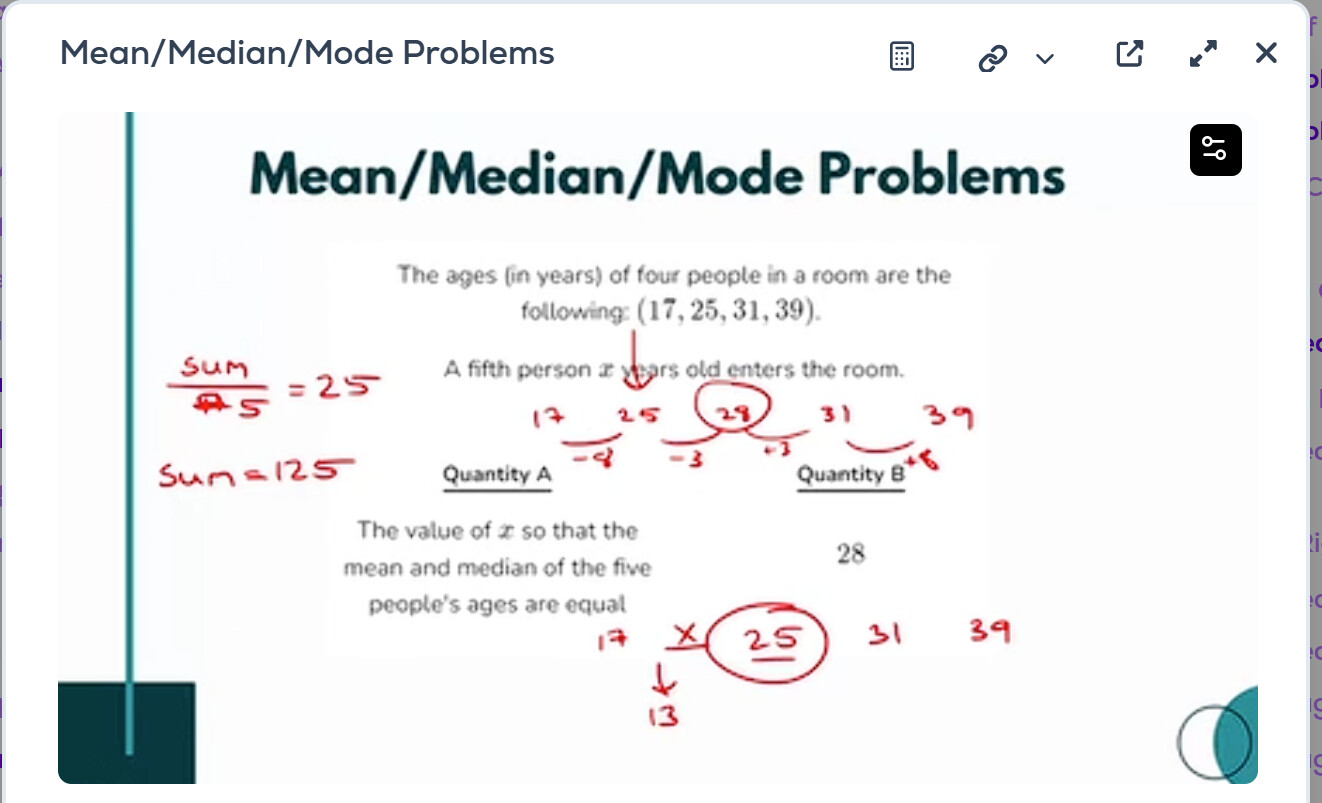
Here Greg says that the mean can also be 25 or one of the other numbers as well, but it doesn’t seem that the suggest set with 13 as the possible x value is symmetrical anymore. Isn’t 28 the only possible value that maintains the symmetry of the set (thus ensuring that the median and mode are equivalent) or am I mistaken?
x can be at 5 positions.
- x, 17, 25, 31, 39
- 17, x, 25, 31, 39
- 17, 25, x, 31, 39
- 17, 25, 31, x, 39
- 17, 25, 31, 39, x
x has to be 13 for (1) and (2) to work, then median = mean = 25
x has to 28 for (3) to work, then median = mean = 28
x has to be 43 for (4) and (5) to work, then median = mean = 43
(2) and (4) become (1) and (5) respectively so only 3 out of the 5 above are possible.
13, 28 and 43 are the possible x-values.
You’re right that the resulting set is not “symmetric” if x = 13, but that’s fine. In essence, symmetry is a sufficient condition for mean = median, but it is not a necessary condition. In slightly simpler terms: if you can verify a set is “symmetric”, then you can guarantee the mean will be equal to the median. However, the reverse is not true; if the mean of a set is equal to the median, that doesn’t automatically mean the set is “symmetric.”
The case you pointed out is one of those cases where you do indeed get mean = median without the set being “symmetric.”
The optimal way to solve this question is to create three cases for what the median could be. In a 5-element list, the median is the third element. In this case, it’s evident that the addition of one specific element cannot make 17 or 39 the middle term regardless of where it’s placed. As such, the only candidates that can be the median (3rd element) are \{25,31,x\}. The rest should be trivial computations, which you can presumably carry out.