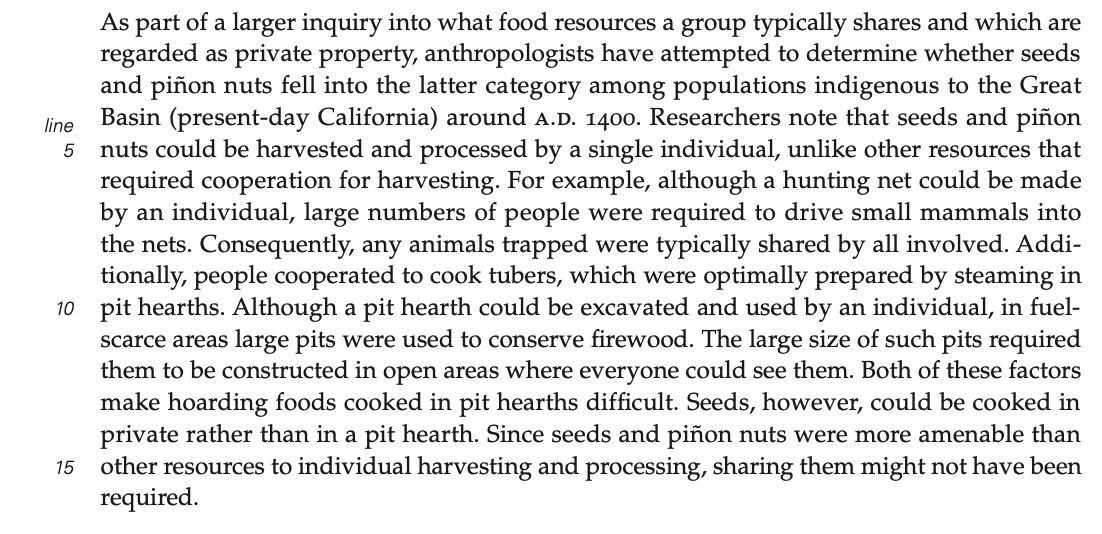
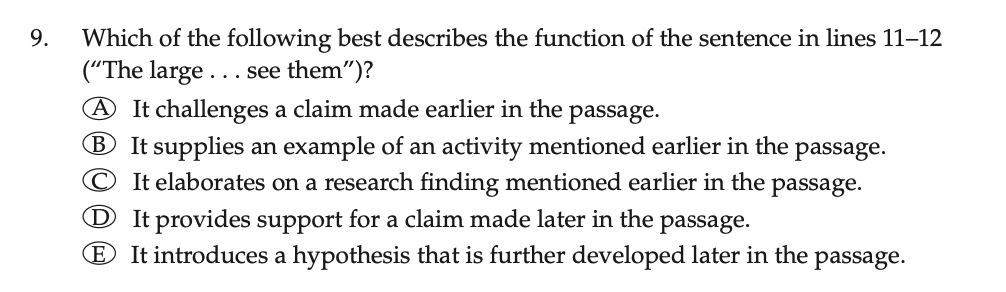
In this question, to me, A and E were easy eliminations (No challenge presented in the passage, and definitely not an introduction to a hypothesis)
For B, couldn’t “cooperation” required for harvesting be an example of an “activity” mentioned in answer choice B? Further, conservation of firewood mentioned in line 11 be an example of the “cooperation” mentioned earlier? This made it difficult to eliminate B.
For C, the passage does mention that “Researchers note” (line 4), doesn’t this “note” make for a “finding” as mentioned in option C? Or does this “note” only pertain to seeds and pinons and not to the other cooperative activities therefore we don’t know whether or not these cooperative activities were research findings (or “notes”) or not?
For D, the claim made later in the passage is that the seeds and pinons could be considered private property, but how does this line provide support for the claim? I was of the opinion that the passage was still giving examples of cooperative activities. Is line “Seeds, however, could be cooked in private rather than in a pit hearth.” the connecting reference where this example is converted into a supporting evidence?
Any help would be appreciated!