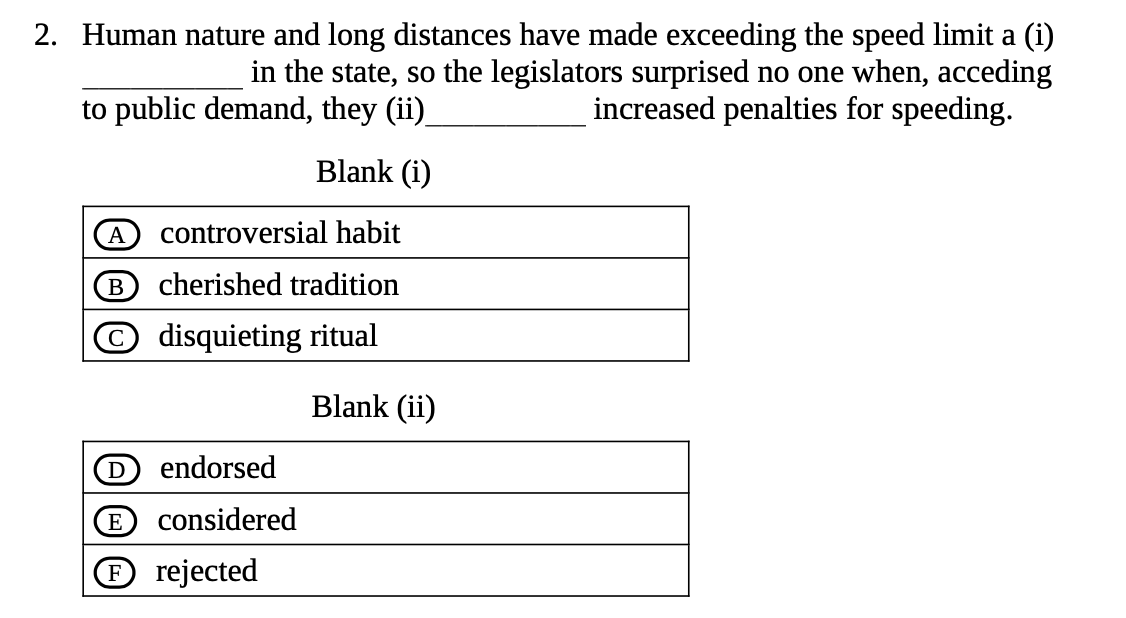
I guess I never really found a satisfactory explanation of this question anywhere. While, I do understand “habit”, “tradition”, and “ritual” all work for the first blank; I don’t really see any evidence for “controversial”, “cherished”, or “disquieting”. I know I saw a video somewhere where one of the tutors cited “Human nature and long distances” to come up with why “cherished tradition” is the correct option here. However, I felt like this explanation has some elements of hindsight bias in it, because to me both “human nature” and “long distances” in themselves carry somewhat of a neutral connotation. And depending on which option is right for the first blank, you can go with “endorsed” (if we pick “disquieting ritual” for the first blank) or “rejected” (if we pick “cherished tradition” for the first blank). Any insight from any of the verbal experts would be appreciated here. Thanks!
When filling in blanks via logic (we do this only about 10% of the time on the GRE), think of cause and effect.
Blank i is the effect caused by “human nature and long distances”. Yes, “cherished” doesn’t really need to be there - generally, we need “must be true” with logic - but in this case, it’s the least bad option.
Thanks for the reply. Could you please elaborate a little bit more on why “cherished” is the least bad option? “controversial” to me is way off, and since we’re now in the realm of could-be-true, how would you eliminate “disquieting’“? Since the speeders could “cherish” this tradition, but others on the road could find it “disquieting”?
Take clues at face value only. Human nature plus long distances = speeding. That’s the only logical equation we can make. Imo “Ritual” is a weird word to use here and disquieting adds friction to the equation whereas cherished decreases friction.