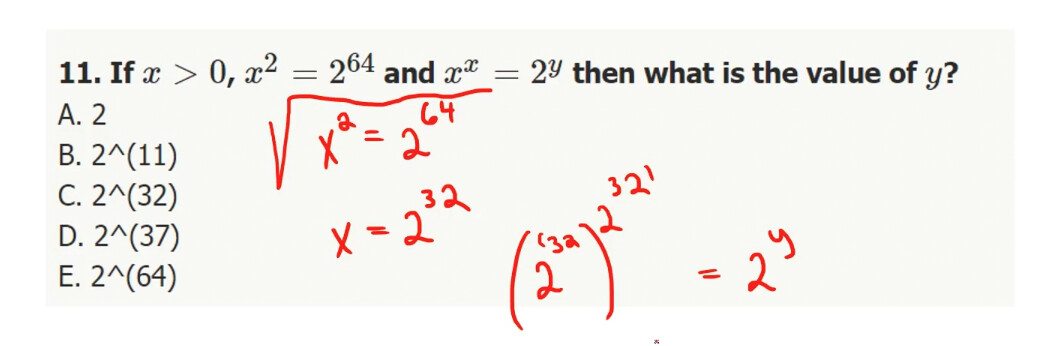
So for this question from tips and tricks session 10, we end up with (2^32)^(2^32). My confusion is, how do we know these parentheses exist? What I mean is, if we have 5^5^5 without parentheses, we go top down with our exponents and get 5^125, we do NOT simply multiply them to get 5^25. But in this question, Greg did add parentheses and multiple them, to give us 2^(32 * 2^32). I figured that parentheses didn’t exist, and we therefore had (2^32)^4,294,967,296 (because 2^32 = 4,294,967,296). So in the way I approached it, the answer would have been different. I did not know we could assume that we could simply do 2^(32 * 2^32). Can somebody help me understand how I was supposed to identify that? Thank you! Sorry if my question is confusing lol.
x^t indicates that the exponent t is applied to the entire base (x).
For x = t = 2^{32}, interpreting the expression as 2^{32^{2^{32}}} would suggest that you are applying the exponent only to the exponent of the base, rather than to the entirety of x itself. This clearly contradicts our above claim.
Fantastic explanation, thank you!