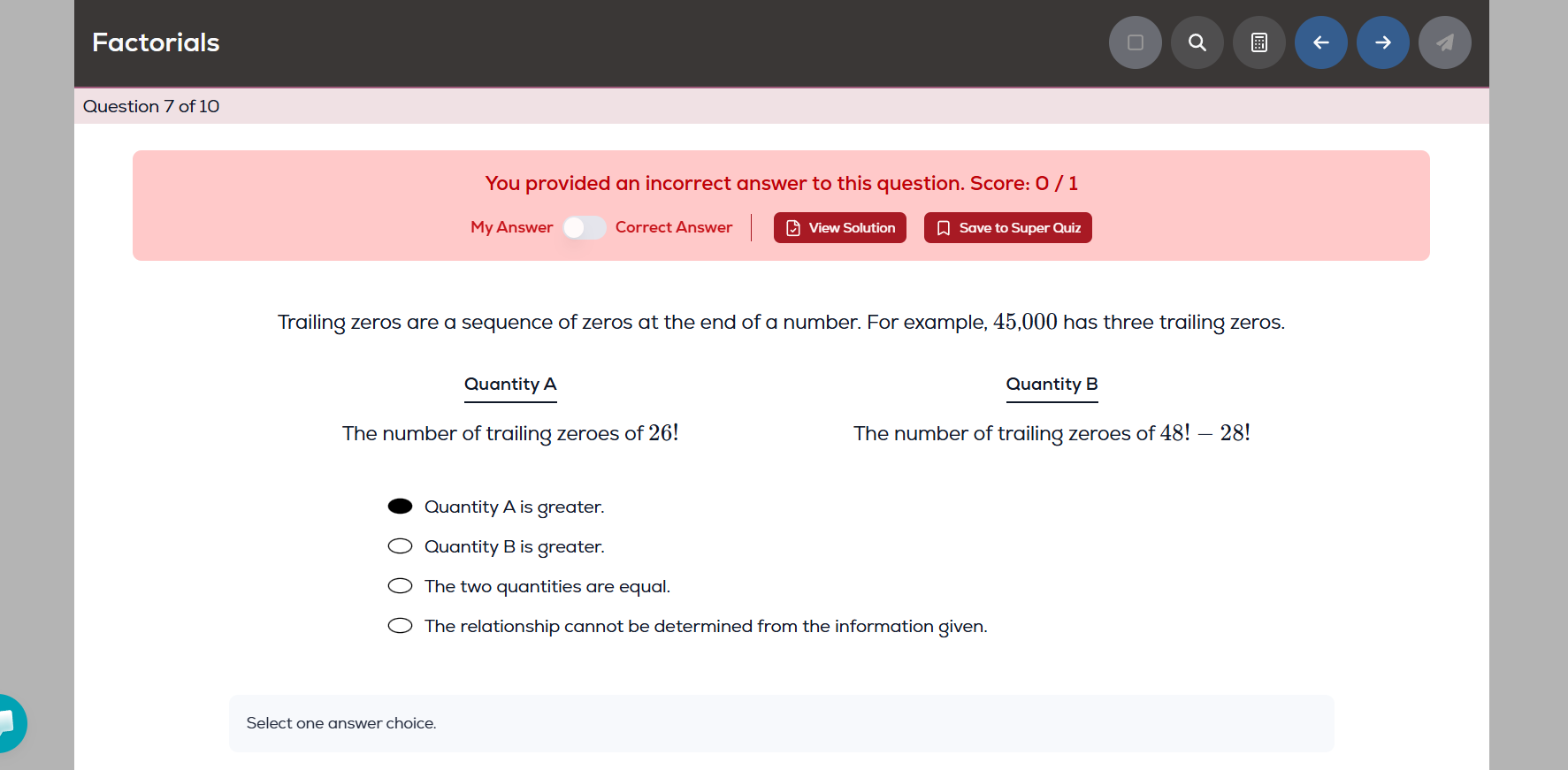
This is a question from Quant Foundation Quizzes, specifically from Topic Based Quant Quizzes - Easy to Hard: Factorials
In this question, I understood the methodology of how to find the number of trailing zeros (finding the number of 5s, cause limiting factor). I also understood why, in Quantity B, finding the number of trailing zeros for 48! and 28! separately, and then subtracting the values doesn’t work (that’s the mistake I made while answering).
But, when we take 28!((48x47x…x29) -1) [I’ll call (48x47x…x29) as ‘a’ for ease of typing], how can we guarantee that (a-1) doesn’t have a trailing zero? If ‘a’ ended with a 1, then wouldn’t (a-1) have atleast 1 trailing zero? In which case, wouldn’t Quantity B be more than Quantity A?
So wouldn’t option D be more accurate than option C?
Can someone please help me out on this? I’m so confused
Such a question would never be D because, if you had access to a powerful calculator, you would obtain a single number for both Quantity A and Quantity B to make a comparison.
What’s the unit digits of a?
I completely agree that a powerful calculator would definitely solve this problem. But unfortunately I wouldn’t be able to calculate the value of the unit digit of ‘a’ in the GRE exam. And now that you’ve mentioned it, I understand how D is unlikely to be an option.
However, how do we find what exactly the value of ‘a’ is in problems like this?
Is there any method or shortcut to know for sure if (a-1) does/doesn’t have any trailing zeros?
Yeah, the intent was to show you that it isn’t possible for the answer to be D, even without having done any math. Because, to reiterate what was mentioned earlier, Quantity A is a fixed number and so is Quantity B, so it’s definitely between A, B, or C.
You don’t. To know if a number ends with a 0, you just have to show that 10 divides it, right? Do you see it now?
1 Like
Yuppp I completely understand now why D can never be the answer. Thank you so much for that!!
But when it comes to proving if a huge number (which is not a factorial) is divisible by 10, I’m still kinda struggling to wrap my head around it, because I’m not aware of any “techniques” to prove that. But I figure such huge numbers will have atleast one 5 and one 2 to create a 10, so (a-1) could never end with a 0? I hope I’m right.
Thank you very much for your time and patience though. I owe you one!
Let’s define p to be the list of all numbers from 29 to 48, inclusive:
p = [29,30, 31, \ldots, 46,47,48]
We also preserve your definition of a:
a = 48 \cdot 47 \cdot \ldots \cdot 29
You can imagine picking a factor of 2 from 48 and a factor of 5 from 45, or alternatively, you can pick another pair of numbers from p that contain at least a 2 or a 5 in their prime factorization. Since there are a handful of multiples of both 5 and 2 available in p, we’re guaranteed to at least have a pair. As such, a is a multiple of 10 because a= (5 \cdot 2) q = 10q for some integer q.
Since 10 divides a, it cannot also divide a - 1. In this context, that means a - 1 does not have a trailing zero.
1 Like
Wow, thank you so very much. This makes solid sense. This is awesome. Thank you so much!!!