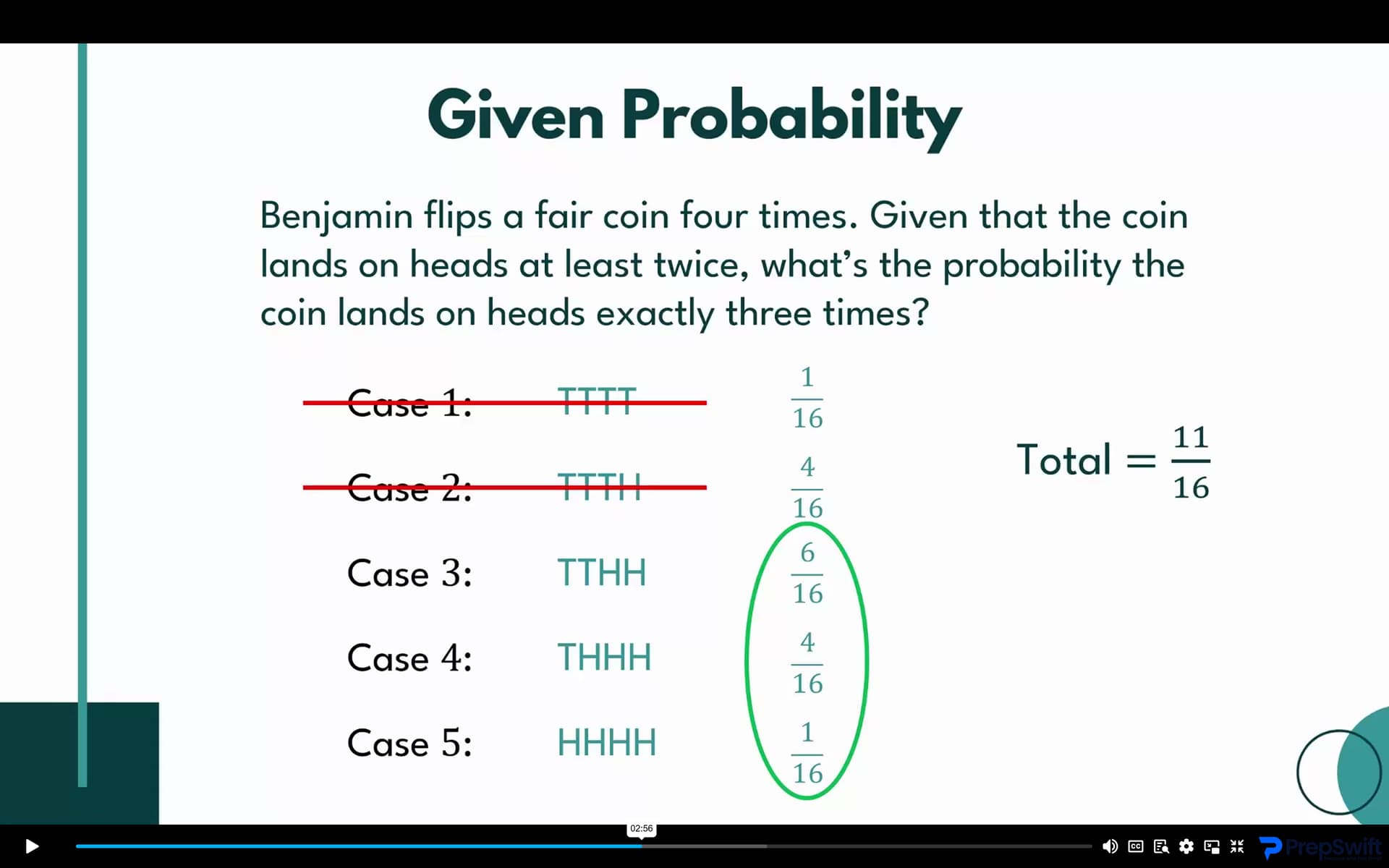
In the screenshotted problem, screenshot 1 shows the solution 1 using combinatorics only. screenshot 2 shows the solution 2 using combinatorics + probability calculations (i.e. [4! / 1! 3!] * [1/2]^4 for case 4 in screenshot 2).
Both solutions work. But, this is a coin toss problem where all probabilities are 1/2. I’m assuming this lets solution 1 work since everything is over the same denominator and nothing is altered by the 1/2 numerator.
Is solution 1 only possible when probabilities of events are all equal like with coin tosses?
If a “given probability” problem like this comes up, but it’s with varying probabilities for each event within each case (i.e. 1/2, 2/3, 1/3 etc) is solution 2 always the best to go with because of everything above?
Ah! Yep, both questions and answers give the answer I’m looking for. Only when all events are equally probably, can the method in solution 1 (using the possible arrangements only) be used. Thank you Leaderboard! And sorry for the duplicate question.