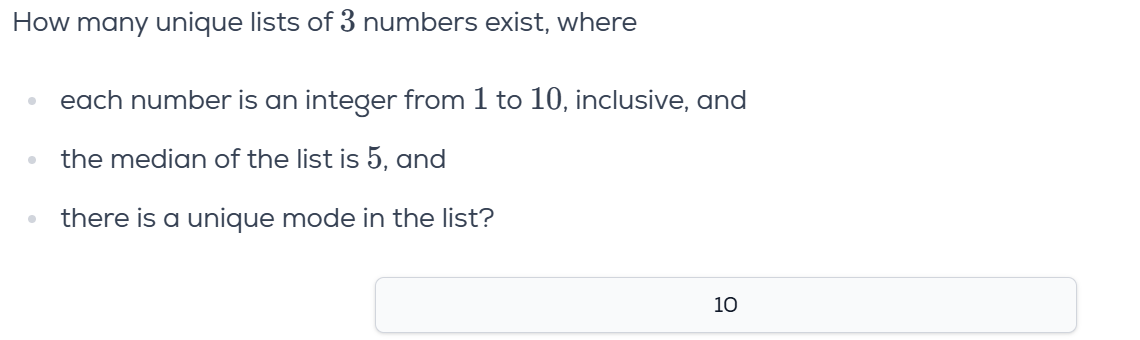
In this question, why is the answer 27, and not 10? Doesn’t “lists” mean ordered data?
Yes, lists means ordered data, so 1,2,3 is a different list than 3,2,1.
Given:
(1) Each number is an integer from 1 to 10 inclusive
(2) The median is 5
(3) There is a unique mode
We are looking for the number of unique lists of 3 numbers with these properties.
-
Since there is an odd number of elements in the list, then the median must be in the list.
-
Since there is a unique mode, then there must be a number that occurs twice or three times, since if all numbers occur once, then all numbers are modes. Thus, we could have 2 5’s or 3 5’s. One five and two other numbers (i.e. 5,6,6) would not work because the median would not be 5.
-
Case 1: 2 5’s
The cases are 55x, x55, and 5x5, where x has to be a number other than 5.
Subcase 1 (55x):
If x < 5, then there are 4 such lists (551, 552, 553, 554). If x > 5, then there are 5 such lists (556,557,558, 559, 55 10). The median in each case is 5 and the unique mode is 5. → 9 total
Subcase 2 (x55):
If x < 5, then there are 4 such lists as above. If x > 5, then there are 5 such lists. → 9 total
Subcase 3 (5x5):
If x < 5, then there are 4 such lists as above. If x > 5, then there are 5 such lists. → 9 total
Case 2: 3 5’s
There is one such case: 555 → 1 list
Thus, there are 9 + 9 + 9 + 1 = 27 + 1 = 28 total unique lists. Please correct me at any step if I made an error. Hope that helps!