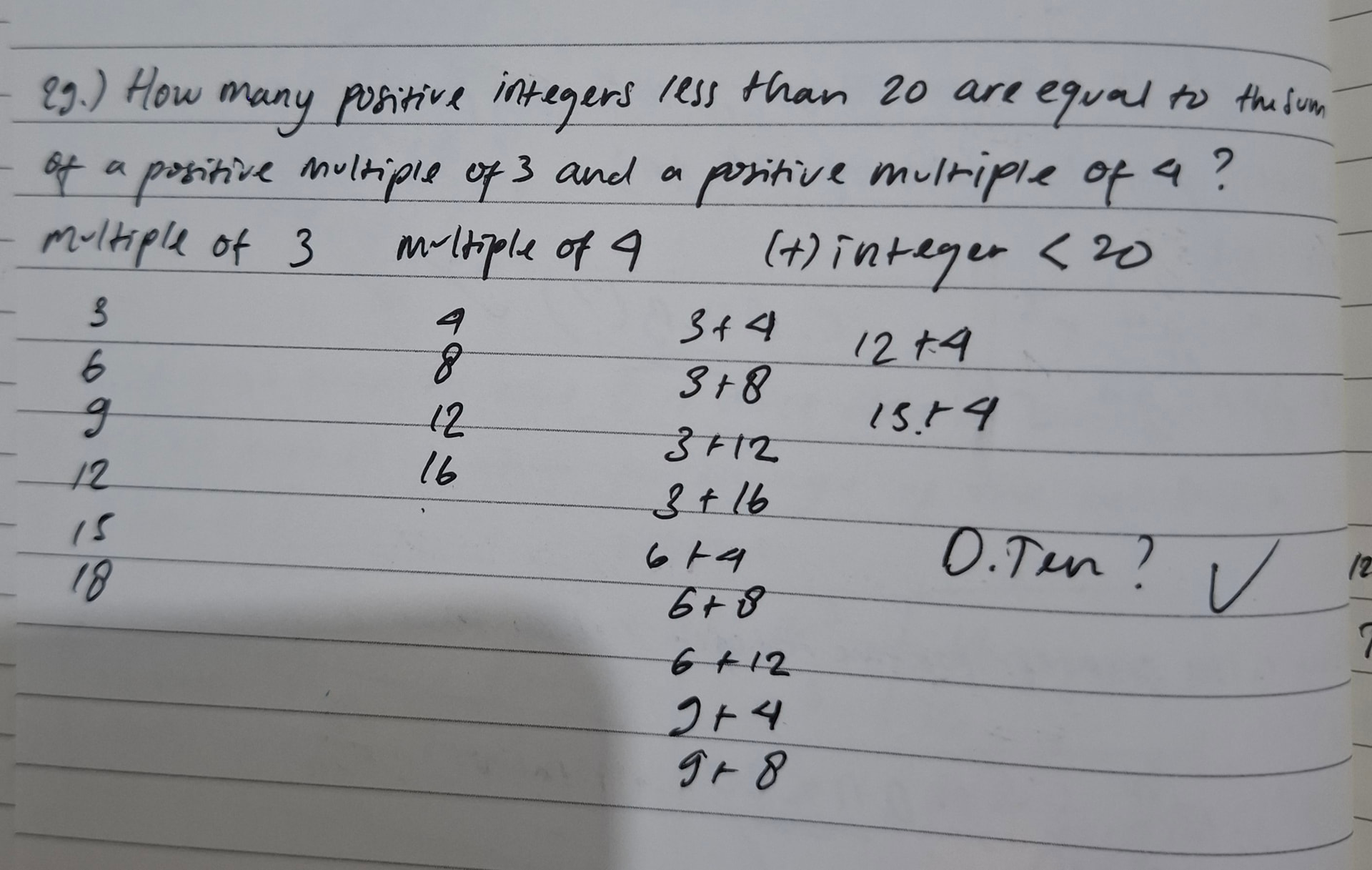
Hi, I came across this problem in GregMat’s 2 month plan [ Week 1 Day 6 - Mega Quant Practice ]
How many positive integers less than 20 are equal to
the sum of a positive multiple of 3 and a positive
multiple of 4 ?
(A) Two
(B) Five
(C) Seven
(D) Ten
(E) Nineteen
On the session, it was solved as -
Factors of 3 - 3, 6, 9, 12, 15, 18
Factors of 4 - 4, 8, 12, 16
And option selected was (D) 10.
However, since 0 is also a positive integer less than 20, and a multiple of 3 and 4 (0 is a multiple of every integer), can we also include 0 as factors of 3 and 4?
So now, the possible sums are -
3, 4, 7, 10, 11, 13, 14, 15, 16, 17, 18, 19?
But, I don’t see 12 as an option. Am I missing something here?
zero is neither positive nor negative
To know more about zero :
Oh right, I got you  Thanks!
Im not understanding how this question was solved in the vide.
The numbers listed were for 3: 4,8, 12, 16 and then for 6: 4, 8, 12, then 7, 11, 15, 19 then 10, 14 , 18 to come up with 10. I have no clue where this came from. Pls help.
This is found in Arithmetic and algebra session 3
I think
6 = 3 \times 2
7 = 3 \times 1 + 4 \times 1
10 = 3 \times 2 + 4 \times 1
So adding 4 to any of the three would be a valid sum of a multiple of 3 and 4.
Hi, I would like to ask why the 15+4 from (3 * 5) and (4 * 1) is not included? Thanks a lot!
p.s: I know finding 19 positive integers is impossible, so I answered D. 10, but just wondering why…?
Here is my note
Not sure where you got that from.
As I understand, 15 is a multiple of 3, and 4 is a multiple of 4. Their sum is still less than 20.
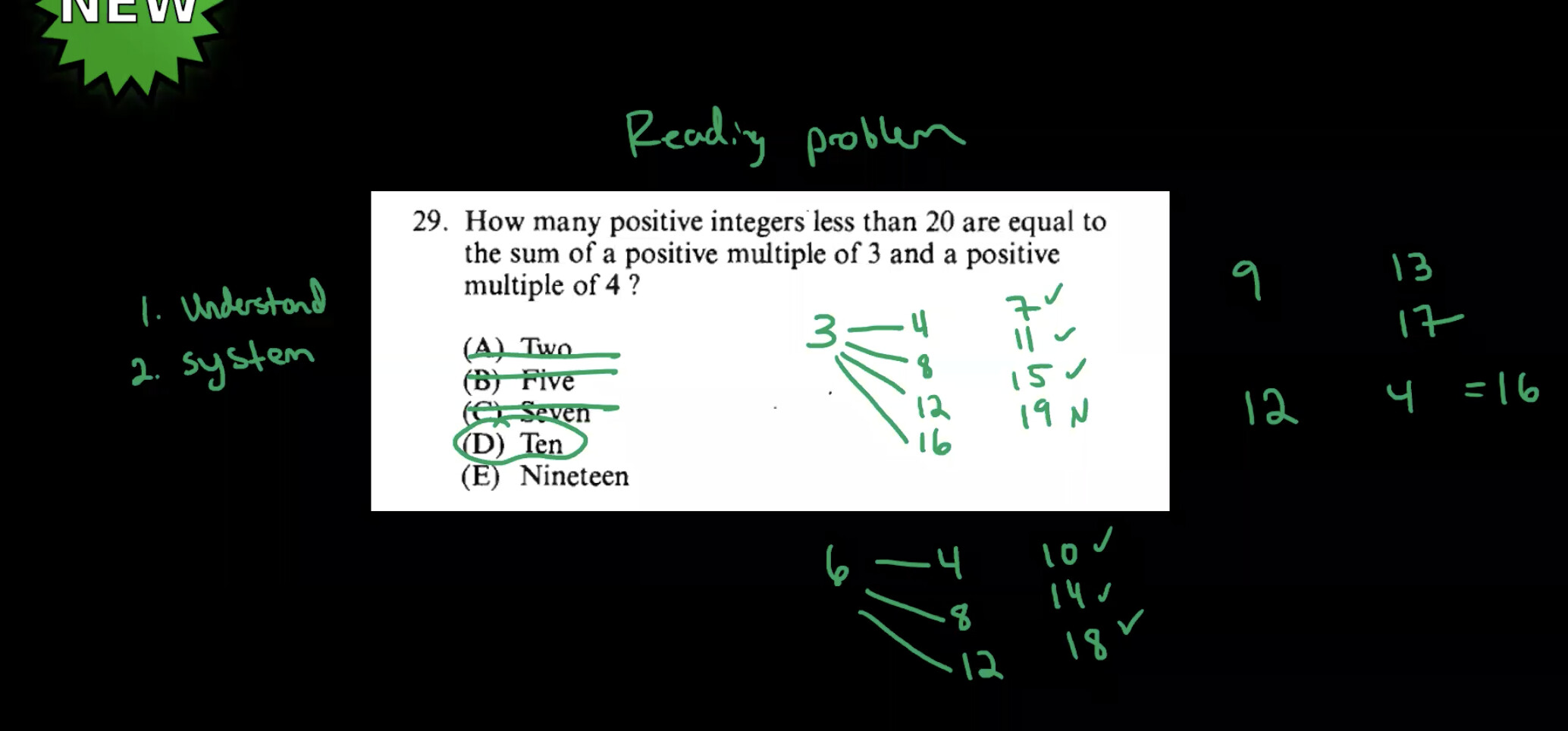
15 + 4 technically counts. The reason it doesn’t here is because we already have another pair that sums up to 19, namely 3 + 16. Hence to avoid double-counting.