Can somebody explain the rationale here, i saw the solution but couldn’t understand a bit about the about the possible value of x. Please help.


Let’s try an example. Suppose n = 1. What would be the answer? What if n = 2?
for the given case at n =1,x = k , only one solution. for even cases x^2 = k, or even x^n = k, there would be only one solution in every case which is x^1/n. How come for n=3 it has 2 solution?
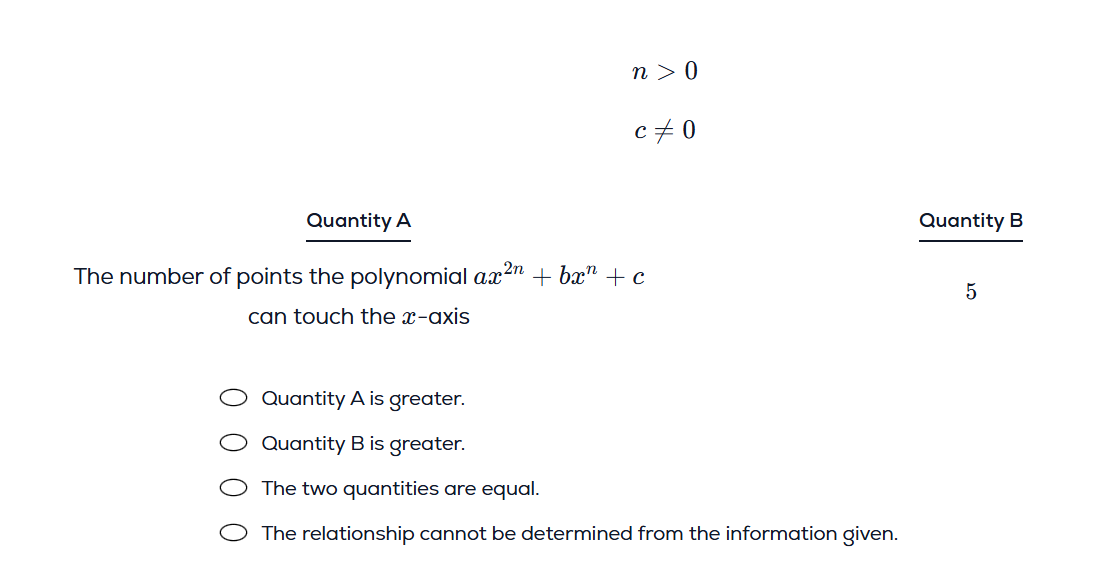
Let’s look at the n = 2 case again. That would be something of the form
ax^4 + bx^2 + c = 0
This can have up to four solutions. Can you find an example? After all, x^2 = k can have up to two solutions (x = \pm \sqrt{k}).
Oh! i was under the impression the negative roots are out of scope of GRE, ETS account for +ve roots, only. That’s why in in last line of the solution when it says (verabtim): “in any other cases (for example, when n=2), there can be only one value of x” (see solution image), I interpreted it as for even x^n = k, there would be only one solution in every case which is x^1/n. even for x^2 = k, x = root k, ONLY.
What really spooked me was for n=3, it has 2 solution for other case it has one.
Can you please explain if possible in detail with hypothetical numbers or equation?
also, i do get your point, for 4 degreed polynomial it can have four solution (and can touch x axis 4 times), and extrapolating this logic possible value of roots = degree of solution, for n = 5, equation will have degree 10 and hence possible 10 roots which can touch x axis and hence greater than 5. I dont get it why not? why 4 is the max one even degreed equation can touch the x axis?
Requesting for detailed and first principle based explanation.
We’ve updated the solution to make it clearer - can you take another look at it and see if that helps?
1 Like
Thanks a ton, now the solution became more comprehensible to be. Just to reiterate my understanding with hypothetical example, to confirm:
if the polynomial is ax^10 + bx^5+ c , then the max no of roots would be 2 and if the polynomial is ax^20+ bx^10+ c, then the max no of roots would be 4. (using the suggested logic)
Correct.
I chose D.
Suppose a+b+c = 0. If we say that n=0, would that not mean an infinite number of points touches the x axis, because the result would be ax^0 + b$x^0$ + c = a+b+c = 0?
What am I missing?
If you take n = 0, you get 0 = 0. The problem is that it’s a meaningless statement as nothing is being plotted in that case.
1 Like
I think OP makes a solid argument about the zero polynomial exception.
0 = 0 is just validating the case that all x work, because every real number is a zero of the zero polynomial, so that checks out. Since “touching” is ambiguous in this context because the zero polynomial can either touch once or infinitely many times depending on perspective, we could potentially sidestep this issue by appending “non-zero” in front of “polynomial” to fix this glaring issue. Another small tweak would be to require positive n because that expression is not a polynomial otherwise.
The question is specifically about touching the x-axis though. Do you mean to say that the statement 0 = 0 could cover the entire xy-plane?
I’m guessing you mentioned the 0 = 0 up top as a result of what one gets when one solves for the roots of f, where f is the zero polynomial. In this case, the resulting 0 = 0 is just affirming that whatever x-value you pick, it satisfies the condition for being a root. As such, all real values of x are valid zeros of the polynomial.
Owing to the above, along with the ambiguity of the word “touching” here, the graph of f(x) = 0 can be viewed as touching the x-axis either one time (at the line level) or infinitely many times (at the point level because all real values of x are valid zeros) depending on perspective.
Therefore, it’s probably ideal to sidestep this issue by disregarding the zero-polynomial exception from the question altogether.
What’s plotted when one says 0 = 0 is more of a context thing. If you were to plot all (x,y) whenever 0 = 0 is true, then we’d shade the entire xy-plane. However, in our context, we are looking for real roots that satisfy 0 = 0. So, if we are strictly concerned with the plot, we would just end up graphing the x-axis (y= 0) itself. Ultimately, I’d say 0 = 0 is more of a tautology we arrive at than something we’re bothered about plotting.
OK, added n \neq 0.
1 Like
Perhaps it’s better just to put “non-zero” in front of the “polynomial…” bit, because as it currently stands, something like a = b = c = 0 still poses the same issue. The “n is an integer” part can likely stay as is.
Yeah, that works