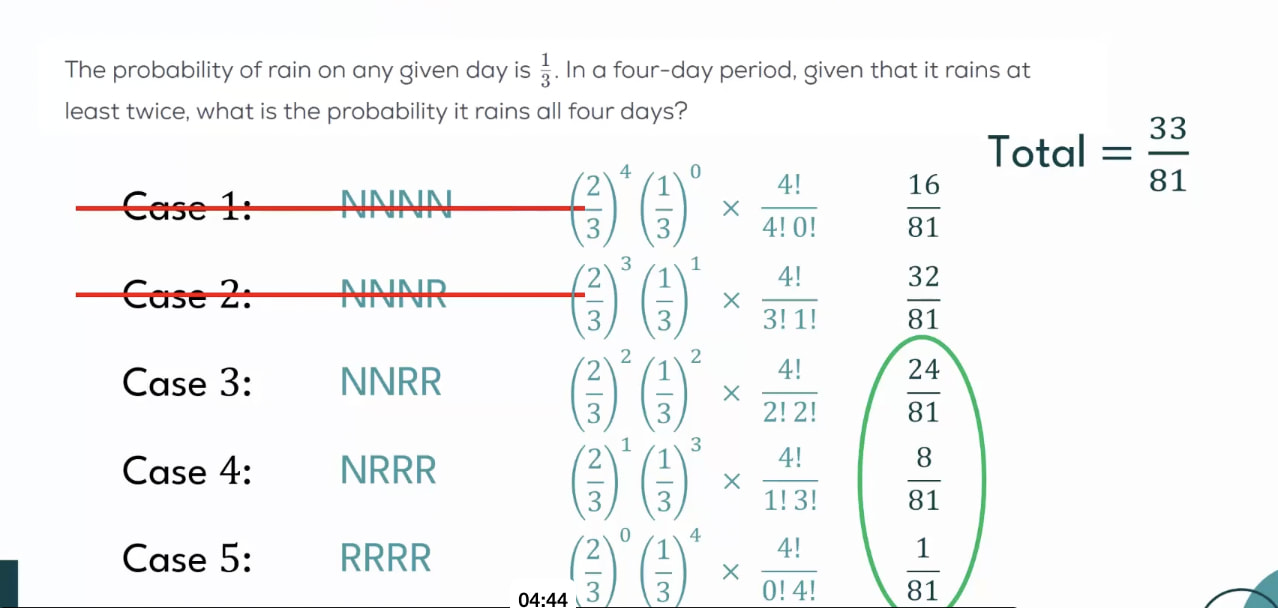
In this question: Given Probability - GregMat
The question is solved using probsbility method, but if I solve using permutation method:
posible permutations:
RRNN: 4!/(2! 2!)
RRRN: 4!/3!
RRRR: 1 (required case)
Total possible arrangements: 6+4+1 = 11
Probability that it rains 4 days a week is 1/11
Now, why does my answer differ from the solution provided using probability method? What am I missing? I seem to have followed the approach suggested in the first question of this video.
Please help, thanks!
Your method assumes that all distinct sequences in \{R, N\}^4 are equiprobable. If the notation is unfamiliar, what I mean is that you’re assuming all 16 possible 4-day sequences, like RRRR and RRNN, are equally likely to happen. This isn’t the case, because P(N) \neq P(R).
Adding to what @cylverixxx mentioned.
Greg suggests two approaches
-
Find the probability of an individual successful event and then multiplying by number of successful events. (How Greg solved it in the image)
-
Find the number of total successful cases and then divide by the total number of cases (given/total whatever the question asks)
You followed approach two (thats what i infered when you said:)
But this method is applicable only when the probability of each event is the same. So use it only when the question mentions throw of a fair die [probability always 1/6] or toss of a fair coin [probability always 1/2].