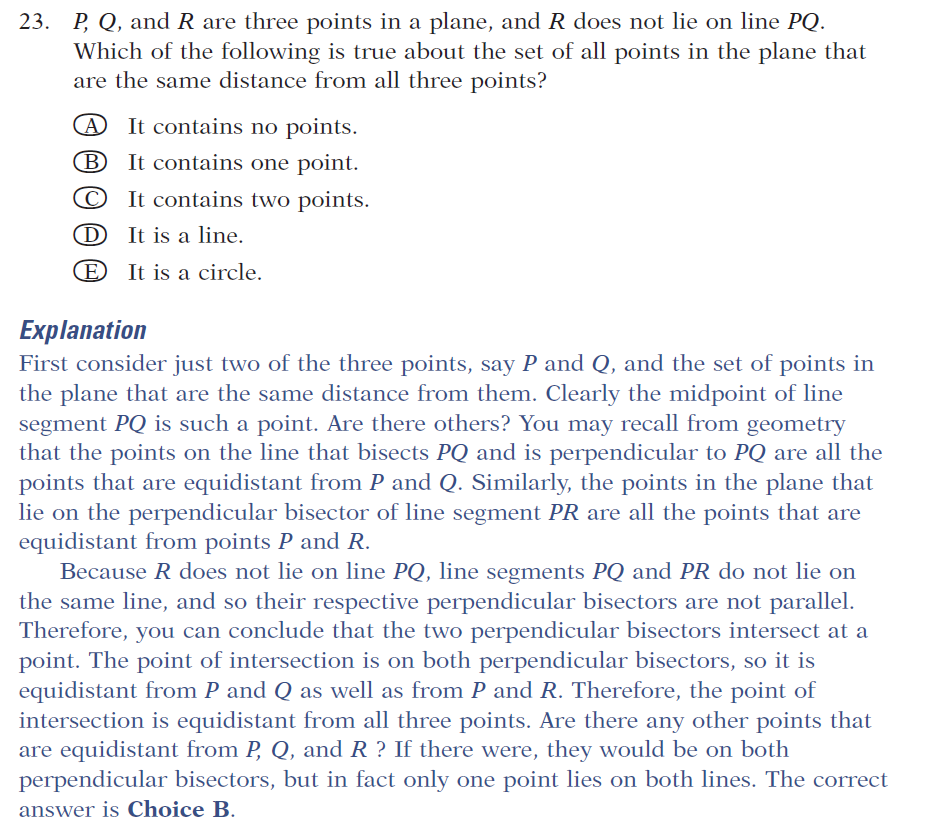
I understand the provided explanation, that’s not my problem. I don’t think it is complete though.
Yes, PQR forms a triangle and the centroid is the only point on that triangle that is equidistant from all 3 points. And then (B) holds true. But, R can be anywhere on the plane (i.e PQR has endless possibilities in said plane). This would mean that point R follows a near circular locus and we get multiple such points. This locus of the point in question is a circle. Doesn’t that make (E) the correct answer?
The only possible explanation I can see here for (B) is that locus is not treated synonymous with set. As it is the same point with multiple possible positions, the set treats it as one point and not a circle. Unfortunately, the explanation does not explain why (E) is wrong which is why I’m having this confusion to begin with.
This is not what they’ve said. The solution doesn’t mention centroids or medians at all, so yeah this assertion is just wrong.
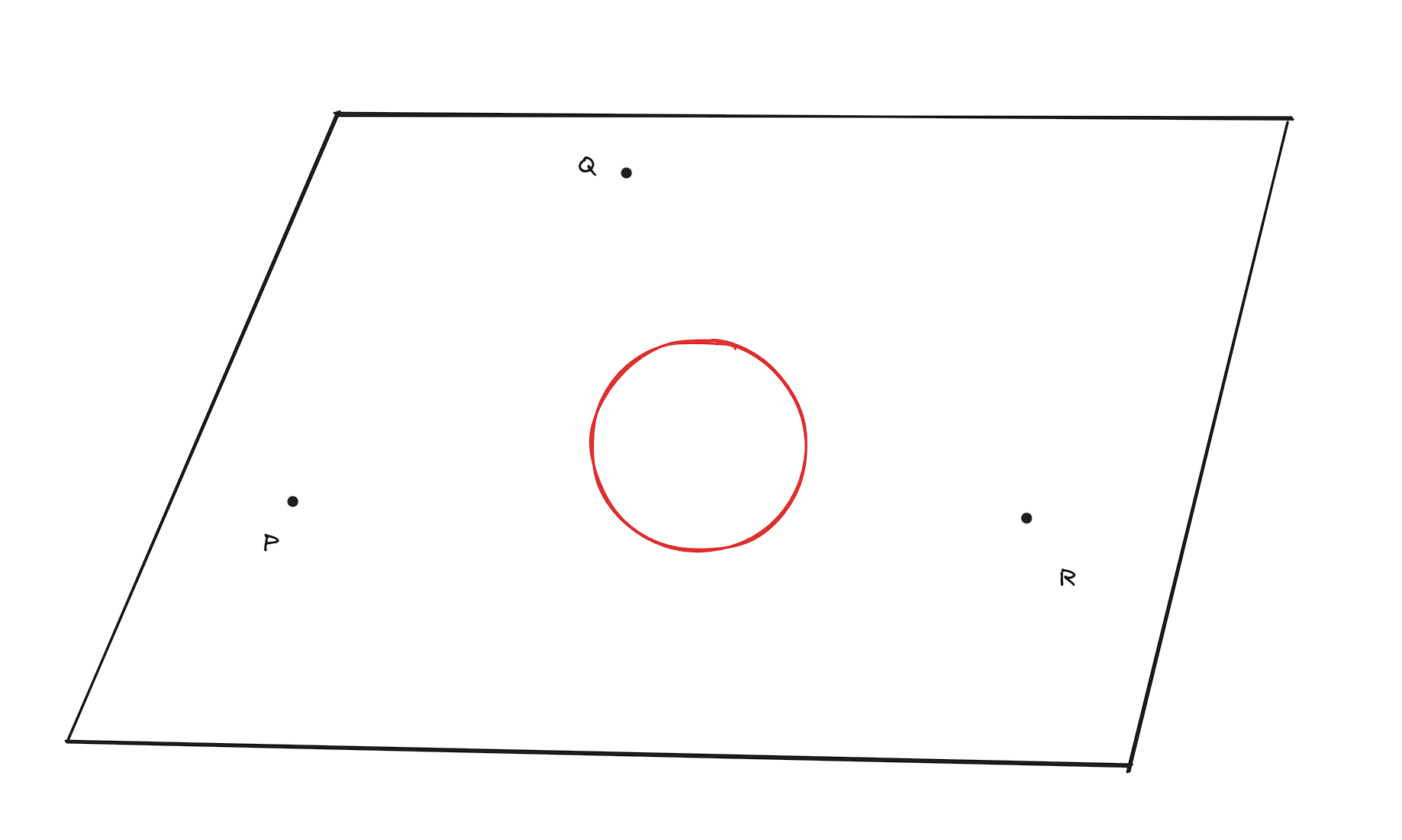
Idk what you mean. You’re claiming that if i give you 3 points (let’s call them fixed points) then you can always find a circle such that every point on that circle is equidistant from those aforementioned fixed points. The solution doesn’t elaborate on this because it should be very easy to explain why this is wrong from just a basic pictorial. The only reason E) exists imo is to exploit people’s tendency to choose circle whenever they see “equidistant” in such a context.
I kept calling it a centroid for convenience, I lost track of what I was saying otherwise. I am not using any properties of centroids or medians here, apologies.
Yes, 3 fixed points is correct. That’s what makes (B) correct. However, If we are to take every point in the plane, there are multiple possibilities of fixing R with respect to P & Q. It will give 3 fixed points regardless, but multiple iterations of it (multiple ways of drawing the said pictorial, R above PQ, R below PQ, and in between). In this aspect, when you map the singular point across all these iterations/possible pictorials in the plane, it traces a circle. The circle in question, is relative to the position of R (it moves with R). That’s not an argument in favor of (E), I just need to know why to not go down that line of reasoning.
According to you (since you think E is right), for any set of three distinct points P, Q, and R in the plane, there exists a red circle such that every point on the circle is equidistant from P, Q, and R. In other words, if we consider a arbitrary point on the circle as X then you’re guaranteed to satisfy |\overline{XP}| = |\overline{XQ}| = |\overline{XR}|, but like this is clearly false. You could hypothesize that there exists such a point on the circumference on the circle, but choosing E suggests that every point on the circle works, which just doesn’t make much sense.
The right way to answer the actual question would look something like:
Given 3 non-collinear points, we can construct a triangle by joining said points. The circumcenter of a triangle is then defined to be the point of concurrency of its perpendicular bisectors. Moreover, it is also the center of the circumscribing circle of our triangle. By definition then it follows that the distance from the circumcenter (center of circumscribing circle) to a vertex is constant because the radius of a circle isn’t variable.