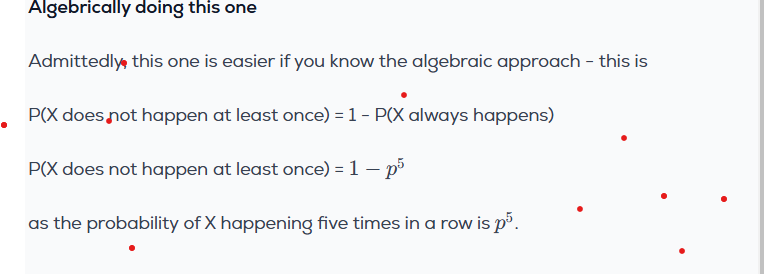
For Question number 8 here: Quiz - GregMat. The algebraic solution says that the probability for x always happening is p^5. How did we calculate this? p is supposed to be the probability of x happening given that y happens right?
Next time could you post the actual question as an image too because it’s hard to kinda follow.

Anyway, X always happening is basically computing the probability of:
X X X X X → This is clearly p^5.
Sorry about that. I thought sharing the link would be more helpful. But that does not get redirected to the actual question.
if p was the probability of X happening then p^5 makes sense. But as per the question, p is the probability that X happening given that event Y happens.
Can you explain the logic on how both the probabilities are equal. i.e Probability that X always happens = Probability that X happens given that Y happens.
Uhhh they’re not.
You get \mathbb{P} (X = 1 \mid Y = 1) = p from the question. Then you’re told that: “at least once, X doesn’t happen”, which translates to:
\mathbb{P} (X^C \geq 1 \mid Y = 5) = 1 - \mathbb{P} (X^C = 0 \mid Y = 5) = 1 - \mathbb{P} (X = 5 \mid Y = 5) = 1 - p^5.
Notice how the conditional (given) probability thing was always “lingering” around and we never admitted to something like: P(X \mid Y) = P(X) (which is not necessarily true).
1 Like
I got it now.
This was very helpful. Thanks!
I have one more question. This seemed like a very tough question until you helped. Would this be categorized as a Easy,Medium or a Hard question?
yeah sure, i guess it’d qualify as a hard question
1 Like