PrepSwift Similar Triangle Problems II

Hi,

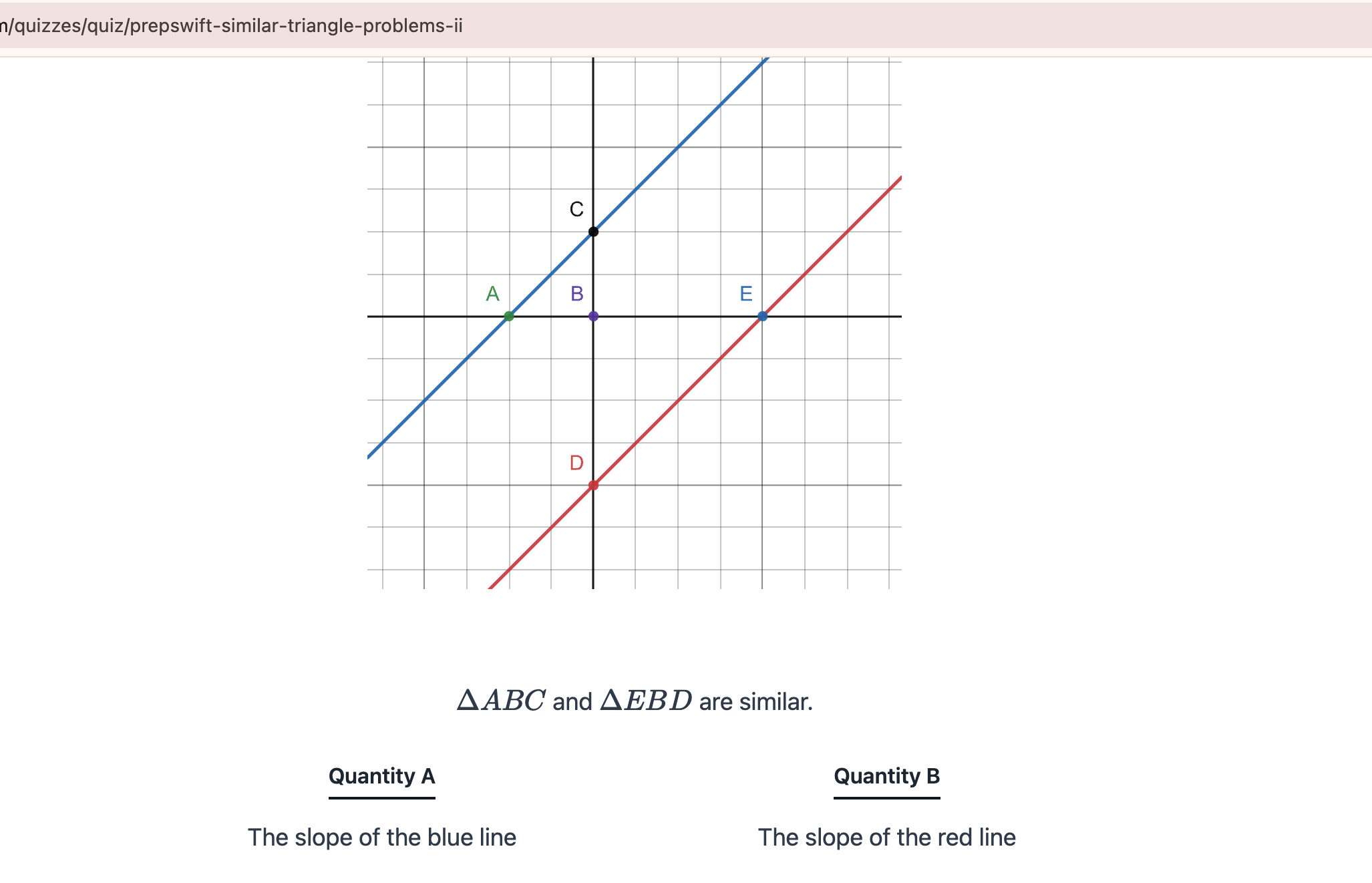
I came across the following similar triangles question:

For this, the answer key mentions that the slopes are equal, and it does make sense from looking at the figure that angle A is equal to angle E, and angle C is equal to angle D.

But there can also be a scenario where the triangles are similar with angle A = angle D and angle C = angle E, correct? In that case, the lines will not be parallel and so the slopes will not be equal.

So in the GRE, are lines and planes (such figures) always drawn to scale? Parallel-looking can be considered parallel and numerically, coordinates can be taken as we see them in the figures?

Thanks!

You can’t just look at the image and decide that it’s parallel or not cuz that defeats the purpose of the whole question.

Since \triangle ABC \sim \triangle EBD then \angle A = \angle E and \angle C = \angle D.

I’m assuming you see those “alternate interior angles” and that suggests that the two lines are parallel. The proof is trivial, but maybe you’re not interested in that so i’ll just skip over that.

Generally, if any one of the “parallel lines cut through a transversal line angle rule” holds then said lines must be parallel.

For reference, this is what I’m referring to when I say “parallel lines cut through a transversal line angle rules”:
Hi,
Thanks for the explanation. I am a bit confused maybe on the following:

Triangle ABC ~ Triangle EBD
In this case, are the angles the same always in order? So it cannot ever be Angle A = Angle D (unless both are 45deg)?

Yeah, the vertex ordering is important

I am a bit confused:

Doesn’t the lines have to be parallel first before we can consider ∠A and ∠E to be alternate interior angles?

I was only able to infer

  • either (∠A = ∠E and ∠C = ∠D) or (∠A = ∠D and ∠C = ∠E) based on the property that similar triangles have equal angles
  • ∠CBA = ∠EBD [as they are opposite and 90°] (based on the graph)
  • I assumed the tranversal to be the line represented by DC, but there was no. info given that AC || DE

If the two triangles were 30-60-90 similar triangles,

  • ∠A and ∠D could be 30
  • ∠C and ∠E could be 60
    which would invalidate the alternate interior angle equality and hence make it not parallel

\triangle ABC \sim \triangle EBD \iff (\angle A \cong \angle E, \angle B \cong \angle B, \angle C \cong \angle D)

Owing to that, it is necessarily the first case.

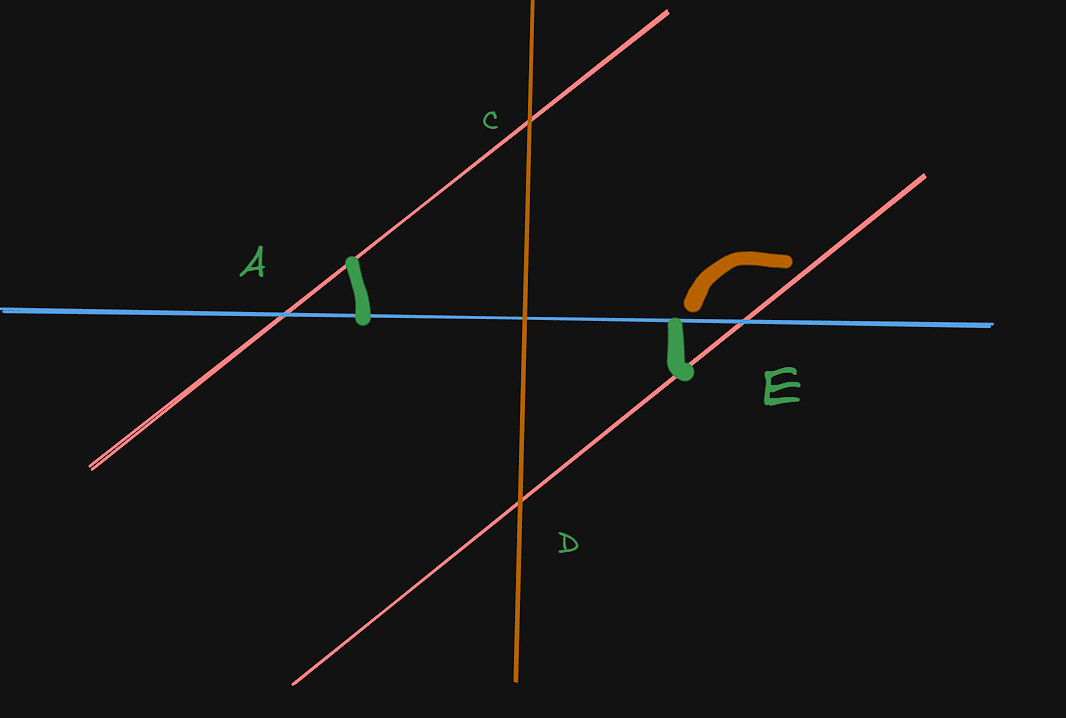
We know that \angle A \cong \angle E (from similarity). Since these are alternate interior angles, it follows AB \parallel DE.

For a quick proof, you can consider the following:

Suppose, for contradiction, that AC \nparallel DE and that they intersect at some point X to the right.

Since the green angles are equal (by similarity as we mentioned earlier), the adjacent brown angle must be 180^{\circ} - \text{green}.

Shifting our focus now to \triangle AXE, we have the following:

\text{green} + \text{brown} + \angle AXE = 180^{\circ}

However, since \text{green} + \text{brown} = 180, \angle AXE is forced to be 0^{\circ}, which is impossible within euclidean geometry.

Thus, our assumption is false, and we must have AC \parallel DE

1 Like

Woah, this is mindblowing! I think this should be part of a Prepswift Concept.

I found that not only that the angles have to match in that order, but even the ratio of the sides have to be that strict, i.e,
AB/EB = BC/BD = AC/ED

Thanks a ton for helping out!