Could someone please explain me the solution? I can’t seem to understand it.
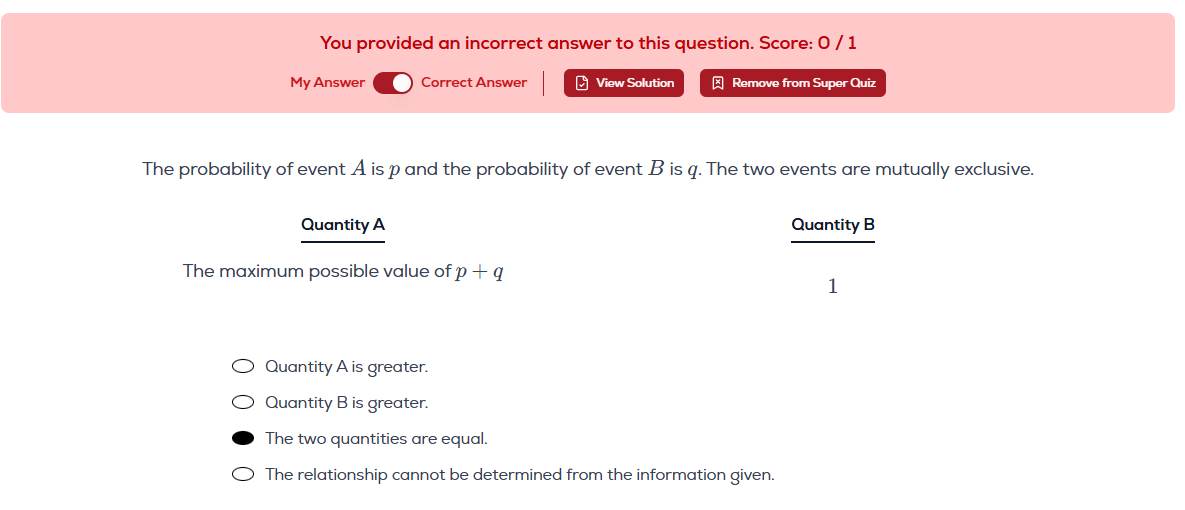
We are given that P(A) = p and P(B) = q and that A and B are mutually exclusive. We are asked to maximize p + q = P(A) + P(B).
Since A and B are mutually exclusive, then P(A or B) = P(A) + P(B) = p + q. Thus, since p + q = P(A or B), then we are actually asked to maximize P(A or B).
Since P(A or B) is a probability, then 0 <= P(A or B) <= 1. However, let’s check if P(A or B) can equal 1 by finding a case.
Suppose event A is rolling an even number on a die and event B is rolling an odd number.
Then, P(A or B) = P(even number or odd number) = P(rolling any number) = 6/6 = 1.
Here is a case where P(A or B) = 1.
Thus, p + q = P(A or B) can equal 1. This is the maximum possible value for p + q. Thus, C is the answer.