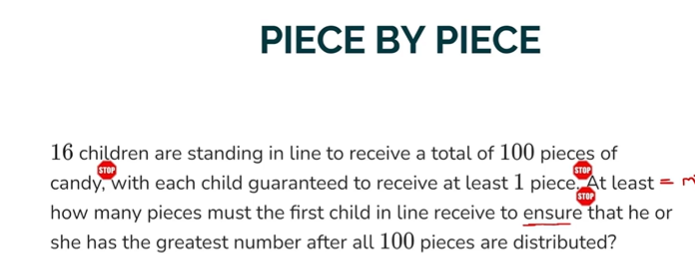
My logic was that the question says “At least how many pieces must the first child get”, so maximizing other’s share such that the condition is met and the first child still receives the least value of such a case.
Could you help explain why that logic would be wrong..?
◆ Every child must receive at least 1, so let’s give every child 1 candy .
After handing 1 candy to each child, we’ll have 84 candies left to share.
Let’s test your scenario:
First child receives 10 candies, and the other 15 children receive 6 candies each.
Imagine the 2nd child decides to give 5 of his 6 candies to the 3rd child,
First child still has 10
Second child now has 1 candy
Third child now has 11 (their own 6 + the 5 Gifted to them)
Suddenly, without breaking the rule, First child no more has the highest
This is why 10 cannot be the answer.
Let’s test why 44 is the correct answer.
If we give first child 44, the next highest can be 42 because, we cannot take anymore candy from any other child as we’ll be breaking the rule above. This is why 44 is the answer.
In case you’re wondering, 44 is the least and 85 is the highest possible.
85 happens when we minimise everybody else’s candy to exactly 1 and give the rest to First child.
 .