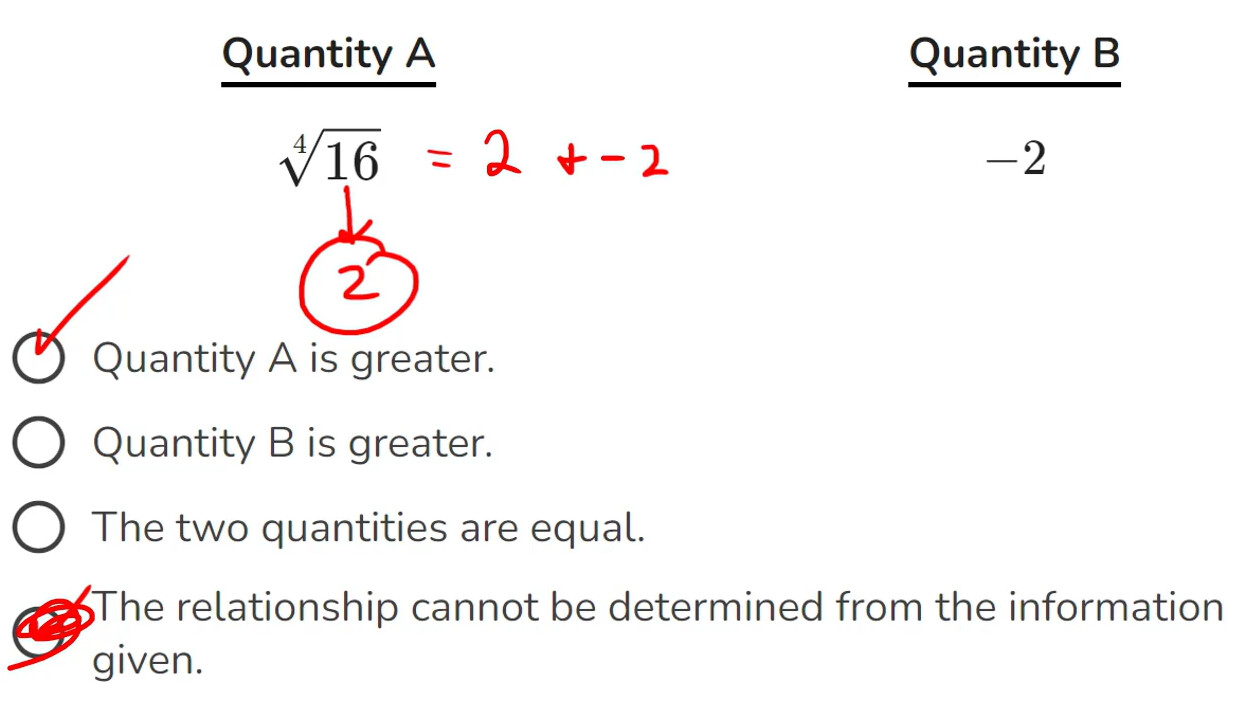
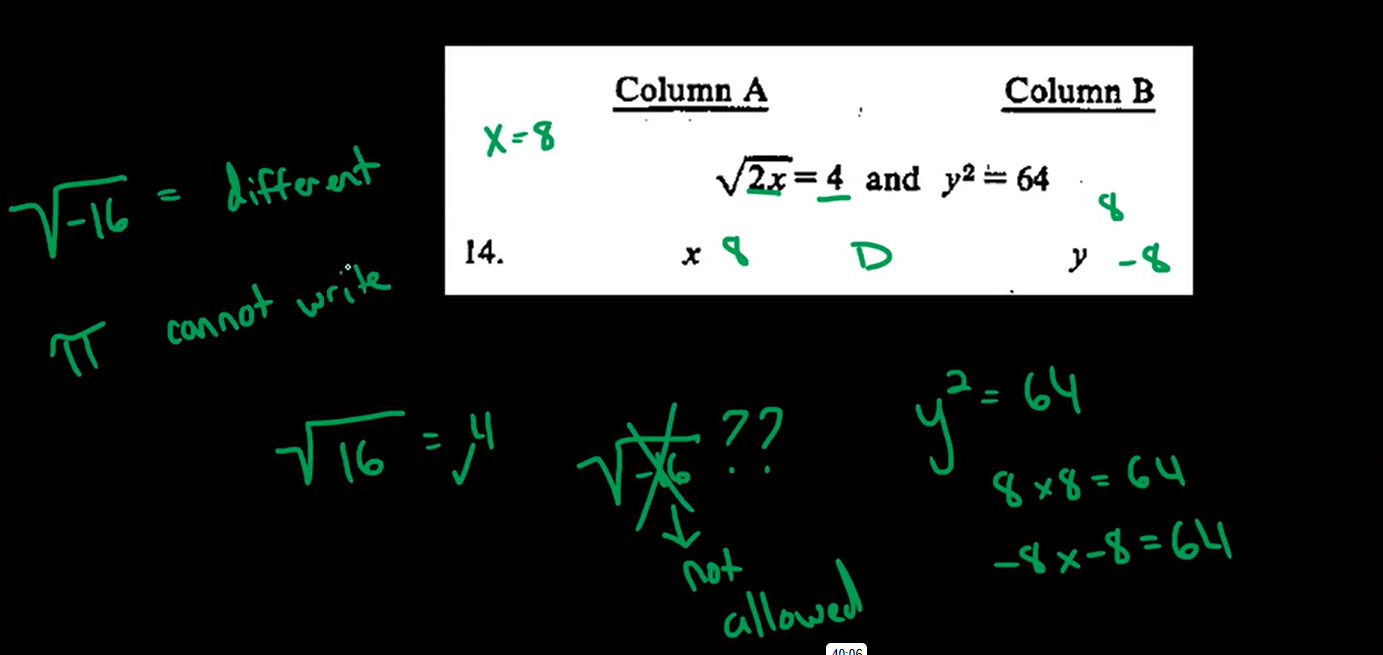
I am very confused about when we are to consider both +ve and -ve solutions and when only +ve solutions.
The first image is from the Arithmetic Foundation Test #1, where I thought that both +ve and -ve solutions of 4th root would be considered. But according to the question, only the +ve solution was correct and Greg says that that’s a common mistake that people make.
My understanding however came from this GRE Dedicated Arithmetic and Algebra Class Session7 (refer image 2). In this class, Greg discussed the above question and he said that for y, we would consider both y=8 and y=-8.
In my understanding of quant and how I usually solve these types of qs is as follows:
y^2 = 64
=> y = (64)^1/2 or sqroot(64)
So, when do we consider both solutions and when do we only consider +ve solutions according to GRE?
\sqrt{.} refers to the principal square root. Every nonnegative number x has a unique (only one) nonnegative square root.
So, whenever you see something like \sqrt{9}, you’re really being asked about the principal square root, which is just 3 (it’s the only nonnegative number that, when squared, gives you 9; a number like -3 is negative so it falls outside this definition). You can extrapolate this “rule” for all even roots.
For something like
The natural way to solve it is to apply the square root (principal) on both sides:
You already know that \sqrt{64} = 8. But remember that \sqrt{y^2} = |y| (hope you know why; if not, just ask).
As a result, your equation is actually:
This absolute value step is precisely why you end up with two solutions (y = 8 and y = -8). It’s not because the square root suddenly started spitting out both positive and negative values. The square root will always return a single non-negative value because it is a function, and by definition, a function pairs one input with exactly one corresponding output.
I get it now. I had missed the |y| part. I’ll keep that in mind.
Thank you so much!