https://www.gregmat.com/quizzes/quiz/prepswift-quant-tickbox-quiz-10-geometry-column-2 (Question 10)
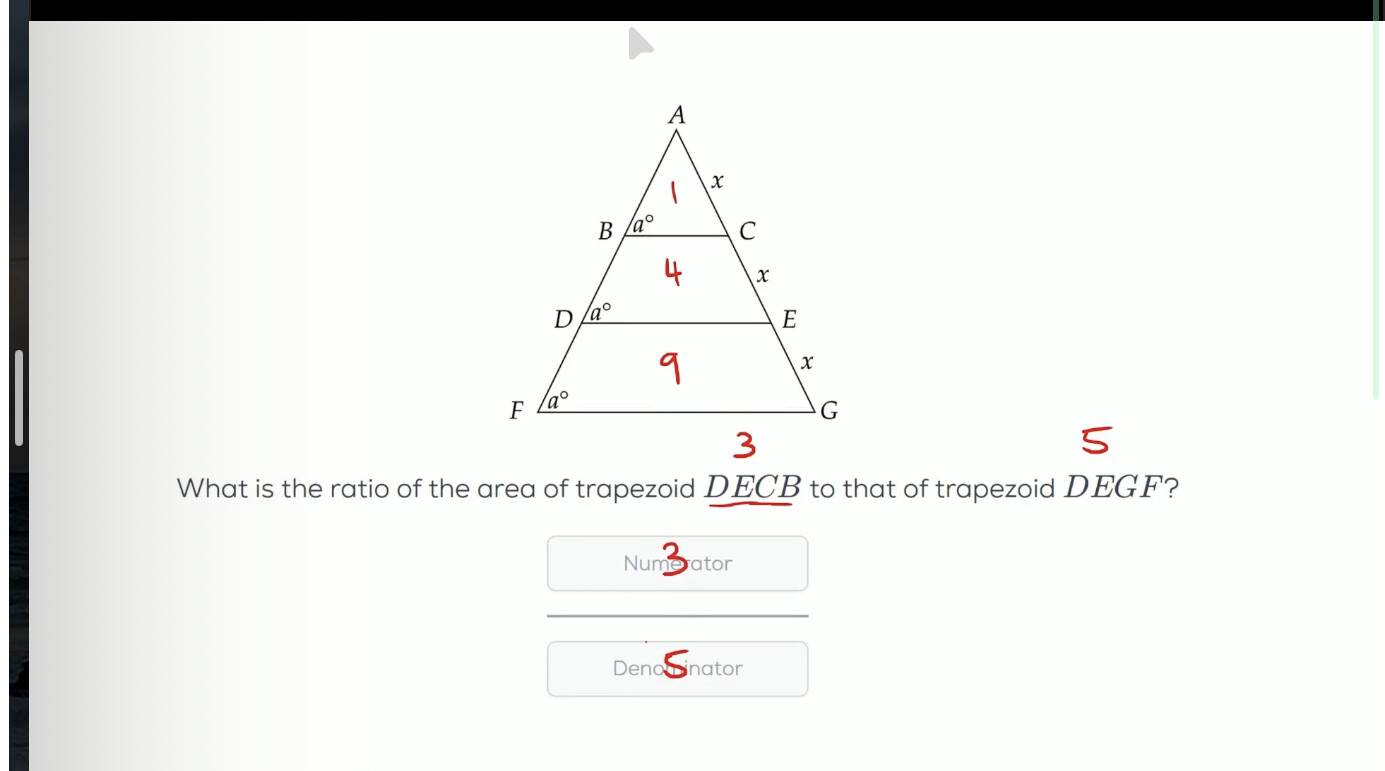
What rule did Greg use to find the areas of the triangles in this problem? I understand how he got the 3:5 ratio, but I don’t understand how he came up with 1, 4, and 9. (I know that 1 could come from 1^2, 2^2, and 3^2, but what rule allows us to do this?
Kweku
November 8, 2026, 9:37am
2
user6613:
What rule did Greg use to find the areas of the triangles in this problem? I understand how he got the 3:5 ratio, but I don’t understand how he came up with 1, 4, and 9. (I know that 1 could come from 1^2, 2^2, and 3^2, but what rule allows us to do this?
It is a rule that follows from the areas of similar polygons. In this case, similar triangles.
Let us use examples to understand why it works.
Consider triangle A with 3-4-5 sides. The area of this triangle is 6.
Consider another triangle B with sides 6-8-10 (ie twice the sides of A). The area of this triangle is 24.
Consider a similar triangle C with 9-12-15 sides (ie three times the sides of A). The area of this triangle is 54.
Notice that B_{Area}=2^2\times{A_{Area}} .
This happens because all the sides of B are 2 times the sides of A,
A_{Area}=\frac{b\times{h}}{2}=\frac{3\times{4}}{2}=6 ,
B_{Area}=\frac{(2b)\times{(2h)}}{2}=2^2\times{\frac{b\times{h}}{2}}=2^2\times{\frac{3\times{4}}{2}}=24
and
C_{Area}=3^2\times{A_{Area}}
Again, this also happens because all the sides of C are 3 times the sides of A, so,
C_{Area}=\frac{(3b)\times{(3h)}}{2}=3^2\times{\frac{b\times{h}}{2}}=3^2\times{\frac{3\times{4}}{2}}=54 .
Generally, given two similar triangles with
\frac{x}{y} ratio of sides,
the ratio of their Areas will be (\frac{x}{y})^2 .
So, if three similar triangles have corresponding side lengths in the ratio 1:2:3 ,; their areas are in the ratio 1^2:2^2:3^2=\boxed{1:4:9} .
I hope this helps explains the values Greg used.