Query about Question 15 from "(I'm Overwhelmed) Algebra Progress Quiz #1 (Version 2)" [7426]

https://prepswift.gregmat.com/quizzes/quiz/im-overwhelmed-algebra-progress-quiz-1-version-2 (Question 15)


I’m not quite following the video explanation for solving this. Mainly I’m not following the set up or perhaps the relationship of factoring negative exponents is lost on me.

why are we pulling out x^-8 and not x^-5? there would be a remainder of x^-3 inside the parenthesis. I know that the question requires the q to be positive, but wouldnt that requirement violate the multiplication exponent rule?
a^n 8 b^n = a^n+m →
x^-5 (1 + x^-3) →
x^-5 + -3 = x^-8
not
x^-5 - -8?
i feel i’m missing something about the factoring of -8. i just dont get why we would when the largest exponent is -5
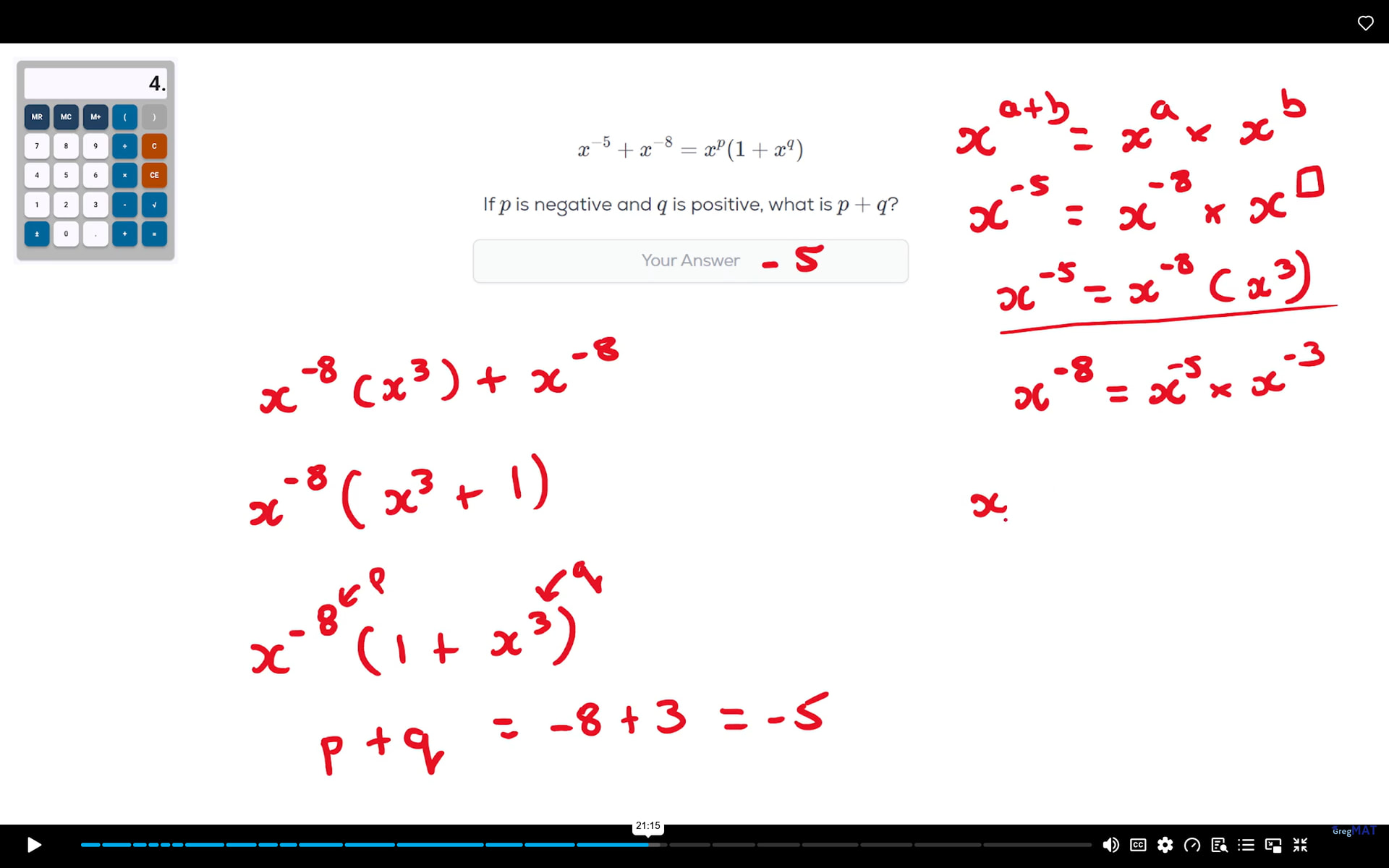
Because we need q=positive.

That is if we factor out x^{-5}. In this case, q is negative. Question however says q must be positive. That is why we instead factorize out x^{-8}.

No.

Let us use simpler examples:

Given x^{24}+x^{6}, we can factorize as x^{6}(x^{18}+1)…this is what we are most used to.

However, this isn’t the only way to factorize. We could instead do:

x^{24}(1+x^{-18}). This is perfectly valid because when we multiply it out, we end up with the original expression of x^{24}+x^{6}.

This is the principle applied in this question.

If all of this is confusing, pick a calculator and do the following calculations:

Let x=2, then,

2^{-5}+2^{-8}=2^{-5}(1+2^{-3})=\frac{1}{32}\times{1.125}=0.03515625

Similarly

2^{-5}+2^{-8}=2^{-8}(2^{3}+1)=\frac{1}{256}\times{9}=0.03515625

Thus, two different terms factored out, yet the same answer. The second approach is what the question demands.