From (I’m Overwhelmed) Arithmetic Progress Quiz # 6, question 13:
Hi everyone! I ran into this problem and wanted to double-check the logic on the answer key:
Here is what the question says:
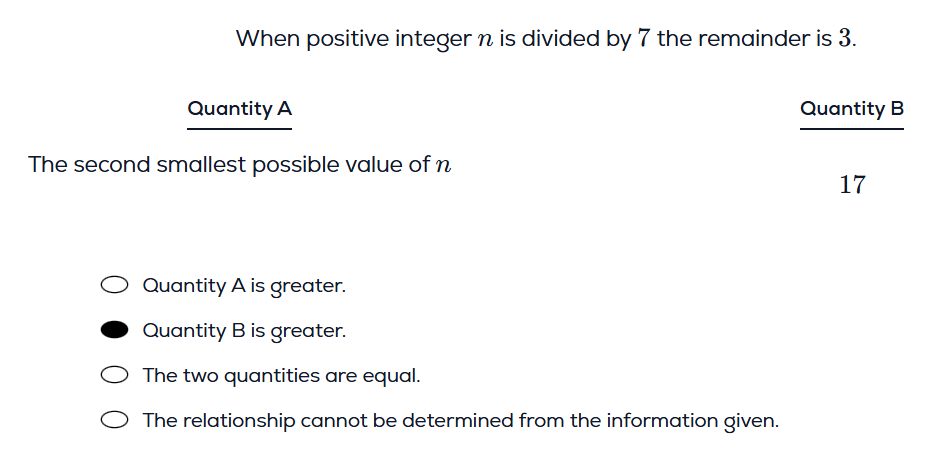
“When positive integer n is divided by 7 the remainder is 3.”
Quantity A: The second smallest possible value of n
Quantity B: 17
The modal/answer key seems to treat 3 as the smallest value of n (implying a multiplier of 0). However, since n is specified as a positive integer, 0 shouldn’t count because 0 is neither positive nor negative.
If n must be a positive integer, the smallest possible value should use a multiplier of 1:
- 7(1) + 3 = 10 (Smallest positive value of n)
- 7(2) + 3 = 17 (Second smallest positive value of n)
If the second smallest value is 17, then Quantity A (17) and Quantity B (17) are equal.
Did the answer key miss the word “positive,” or am I misinterpreting how 0 interacts with positive integer remainders here? Thanks!