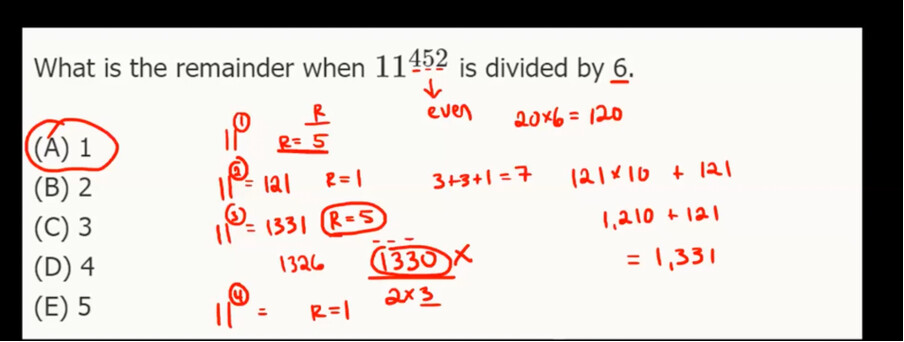
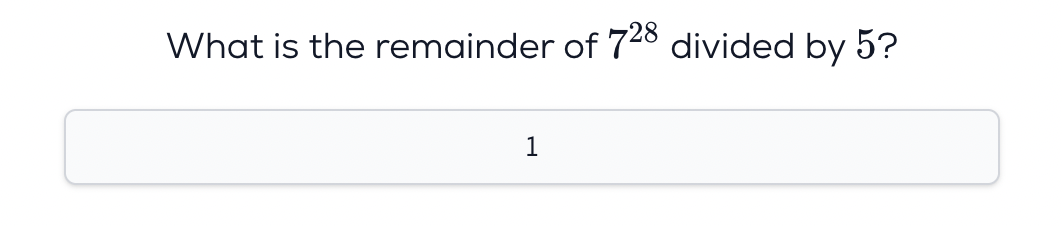
Why is it that when a number ends with numbers from 2-9 we just refer to the pattern we had identified. 2: 2,4,8,6 ; 3:3,9,7,1…and solve questions like 3^21 divided by using these series but we have a question like 11^453 divided by 6 we don’t assume that the pattern of 1 is 1,1,1,1?
There are two question types that you might be conflating:
What is the unit digit of x^y?, where \text{x and y are positive integers}.
What is the remainder when x^y is divided by n Or what is the remainder of \frac{x^y}{n}, where \text{x, y and n are positive integers}
What is the unit digit of say 23⁴⁷?
What is the unit digit of 11⁴⁵³? The answer is 1 because the pattern is 1,1,1,1.
What is the unit digit of 2⁶⁹?
In all of these questions, we go through the cyclicity you have shared, including when the number ends with 1.
Notice here, we are asked for the remainders, not the unit digits.
In this instance, we go through the process Greg did, ie, finding the remainders as the exponents increase until we get a pattern we can then extrapolate to find the answer.
Hence, the approach used to find the answer to both of the questions in the screenshot is the same.
Divided by what? My guess is 3²¹ divided by 10. Lmk if that was not your intention.
And the full question I am guessing, is: What is the remainder when 3²¹ is divided by 10.
If any part of this is unclear, do not hesitate to ask.