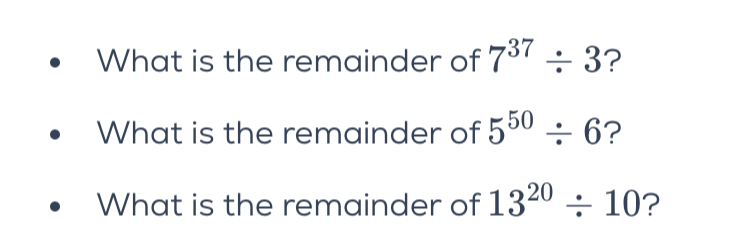
I have noticed that in most cases we are asked a question which gives us a big number in the numerator that has a large power with a simple denominator, as in the example found in the Remainder and Exponents mountain entry in the “I’m Overwhelmed Plan”.
The method of solving it seems simple. Write down the first few remainders till a pattern becomes apparent, and then take it from there. Makes sense.
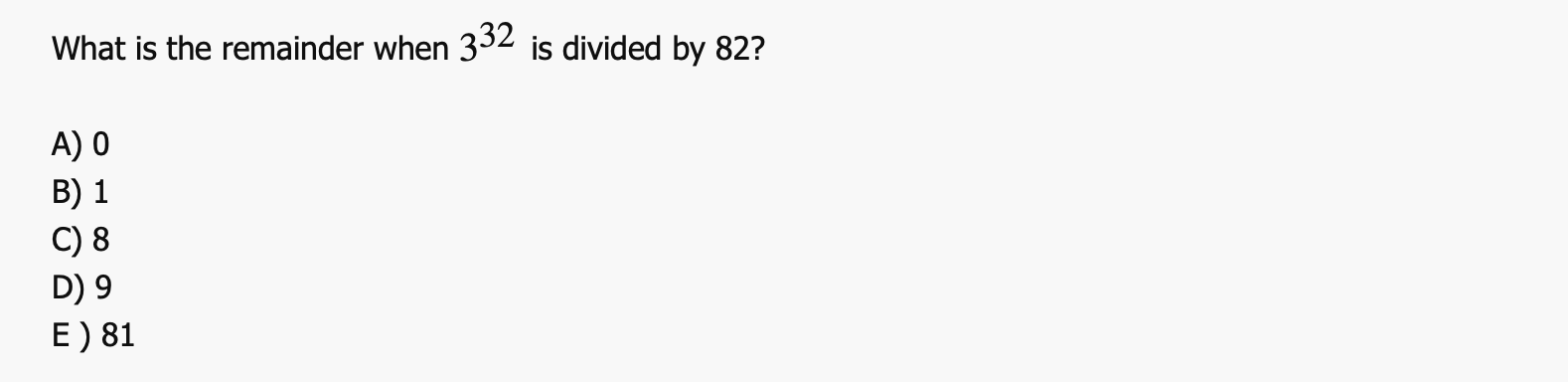
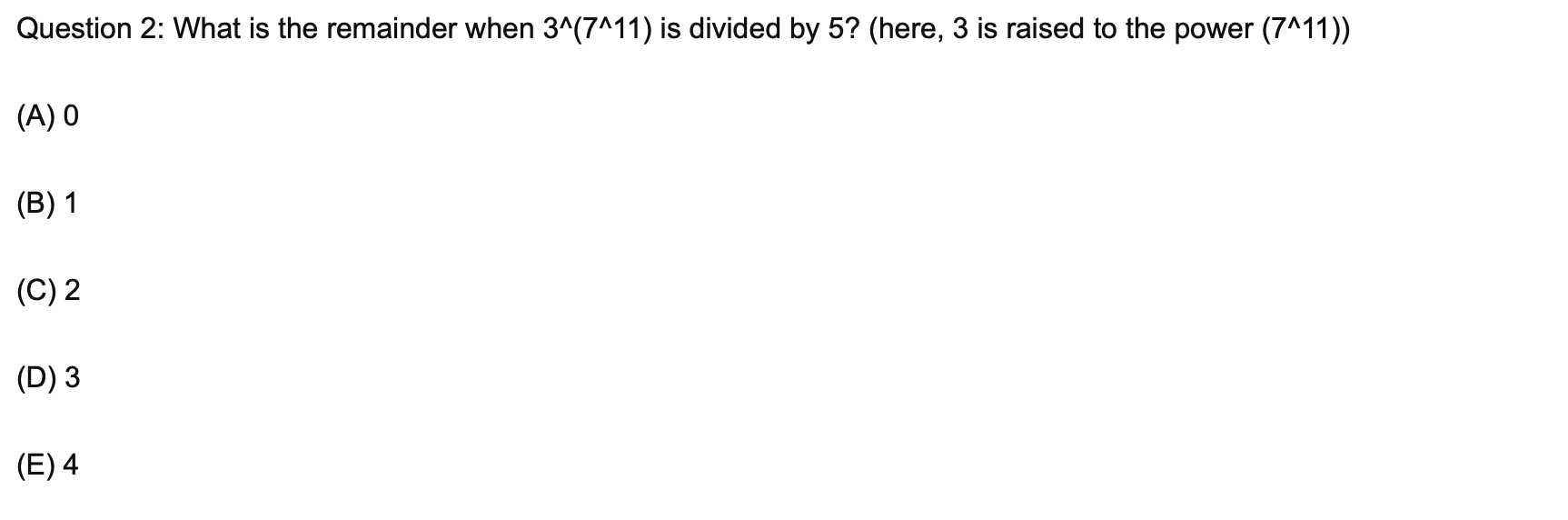
But, going through the mountain today, I was wondering what if the denominator is not as simple as the ones above. What if the denominator has a power or is just a large number itself? What if the numerator is an even larger number? I found some interesting and fun examples, but was uncertain whether they fit the GRE question format as I found them mostly answered on the GMAT forums when I did some digging in an effort to assuage my curiosity (which in hindsight perhaps only made it greater). Examples attached (pictures 2 and 3).
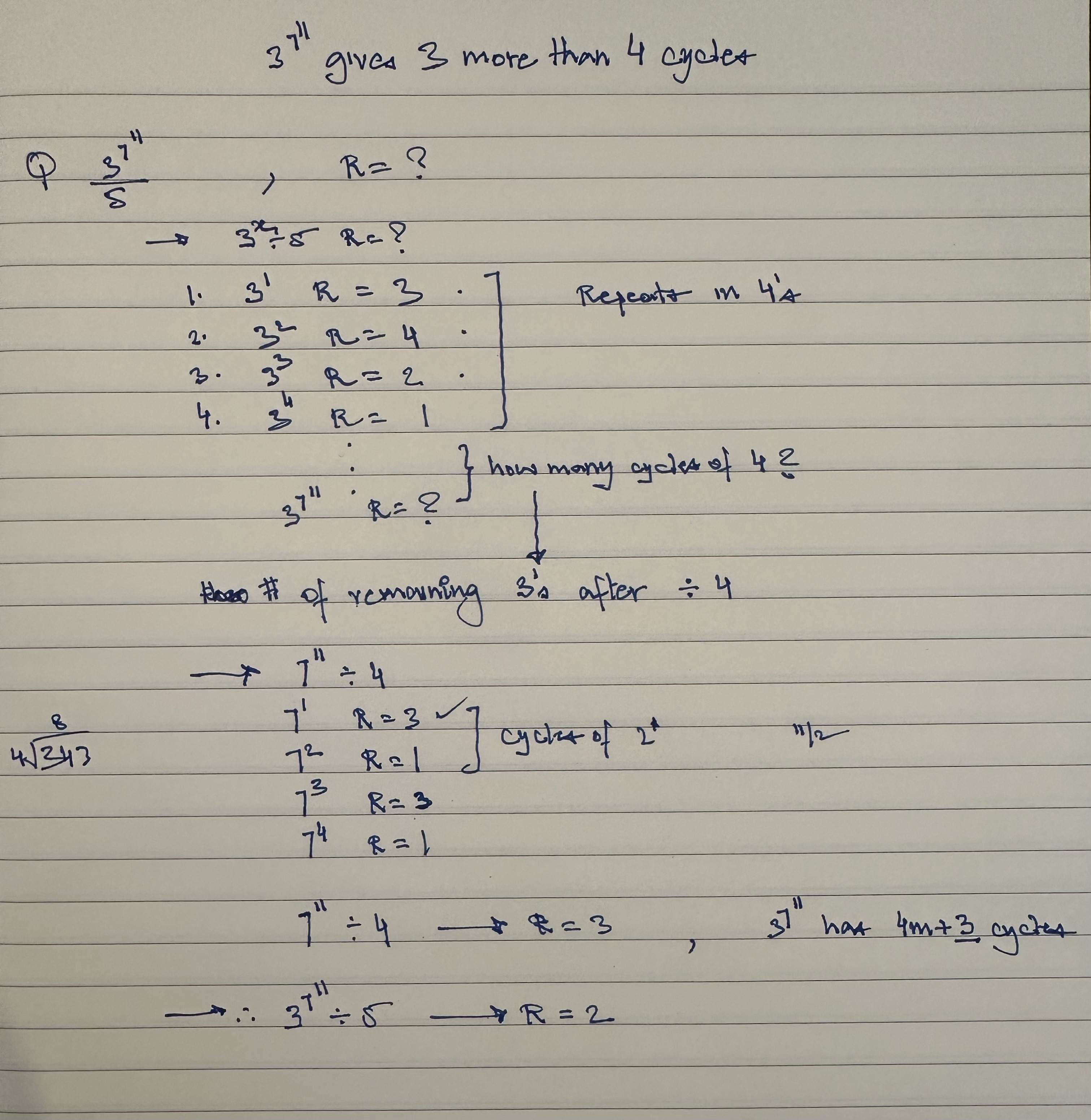
The first one could be solved in an algebraic way by simplifying the numerator and denominator. The second one particularly seemed interesting: familiar but with an additional step. It requires us to essentially apply the pattern recognition method twice (picture 4)! Was just curious as I stumbled upon thought while going through the mountain, so thought I’d ask. Apologies for the verbose post…
I guess I meant larger than the single digit denominators, which is why I was initially stumped by the first question with 82 as the denominator. Because so far I had only seen straightforward versions. The second one was just an example for a larger numerator. I wasn’t as such able to find examples with large divisors, in my brief foray
It’s more or less going to be at that level. There are limitations to what they can ask, because the tools given to you on the GRE are limited. Questions with large “denominators” are usually reserved for more advanced elementary number theory and aren’t essentially what’s covered on the GRE.
Also, your Question 1 just hinges on realizing that 3^4 = 81, so it’s fair to assume that’s the level of questions you can expect for larger “denominators."
Ah okay. This clears up my anxiety! I wasn’t quite sure about how to gauge question levels as I hadn’t seen much about these kinds on the material I saw so far. But this gives me confidence. Appreciate the response! Apologies for the stupid question, lol.