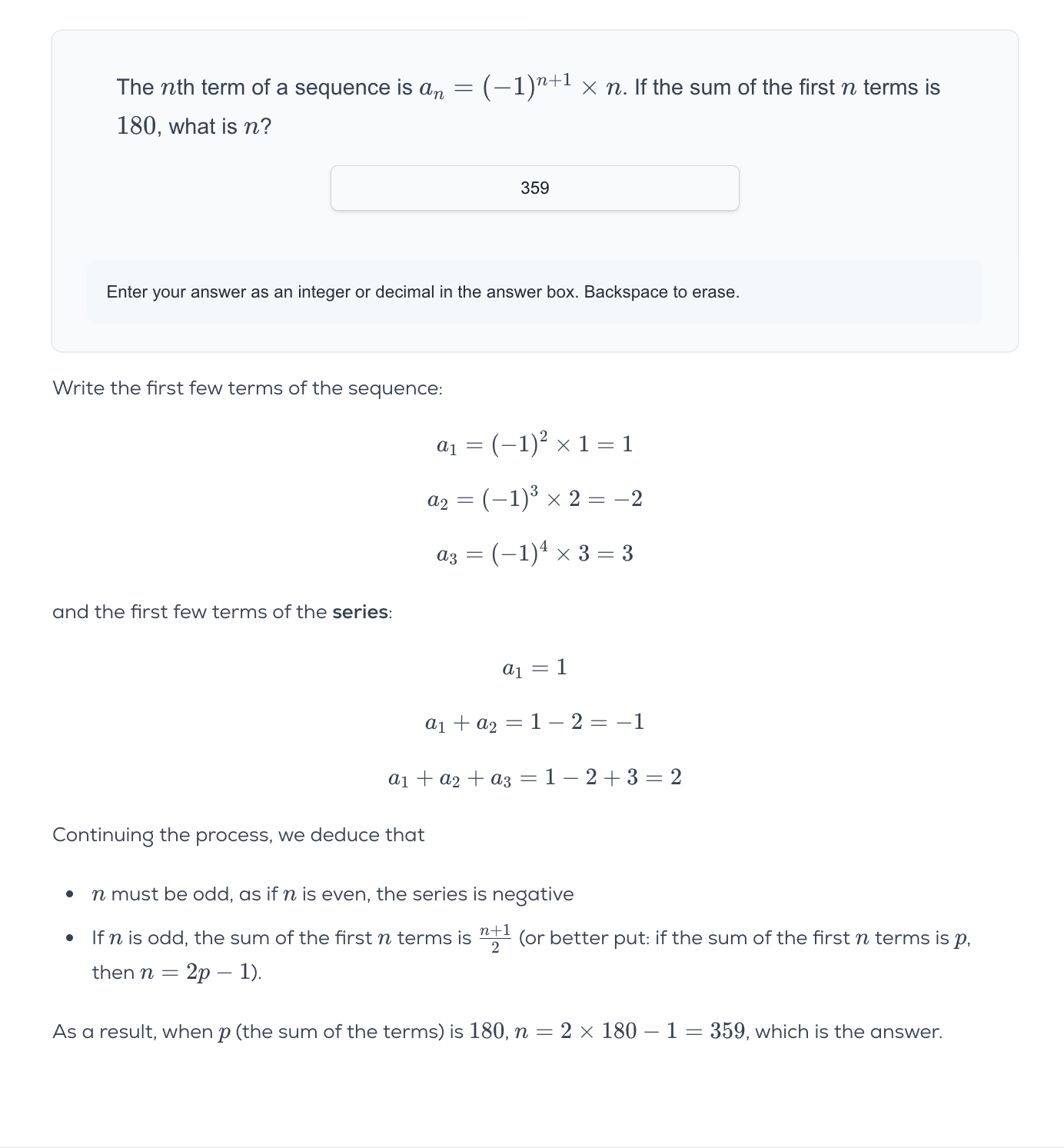
Here, in the second last row, shouldn’t the formula for the sum of the first n terms be n(n+1) / 2? (I remember this from Arithmetic + via the Mean = Sum / Number formula). Could someone please clarify if I’m reading into this incorrectly?
Thank you.
Your formula is specifically tailored for the sum of the first n consecutive positive integers. The sequence provided is clearly not a sequence of n consecutive positive integers, so it wouldn’t make sense to apply that formula.
Makes sense. So is there is a general form of this formula? I’m trying to understand how they’ve arrived at it.
When you’re solving these types of problems on the GRE, you generally want to start by looking for a pattern. In this case, grouping consecutive integers reveals a pretty clear one:
\underbrace{(1 - 2)}_{-1} + \underbrace{(3 - 4)}_{-1} + \underbrace{(5 - 6)}_{-1} + \ldots
As you can see, every consecutive pair adds up to -1. From there, you just need to calculate the total number of pairs (assuming there is an integer number of pairs).
If the number of pairs isn’t an integer, then you can just calculate the sum of all the complete pairs, and add the value of the final, unpaired number at the end.
You can certainly derive one now! In general, however, you aren’t expected to know the closed form of every “random” series you come across. You just study the pattern, try to understand the underlying structure, and go from there.