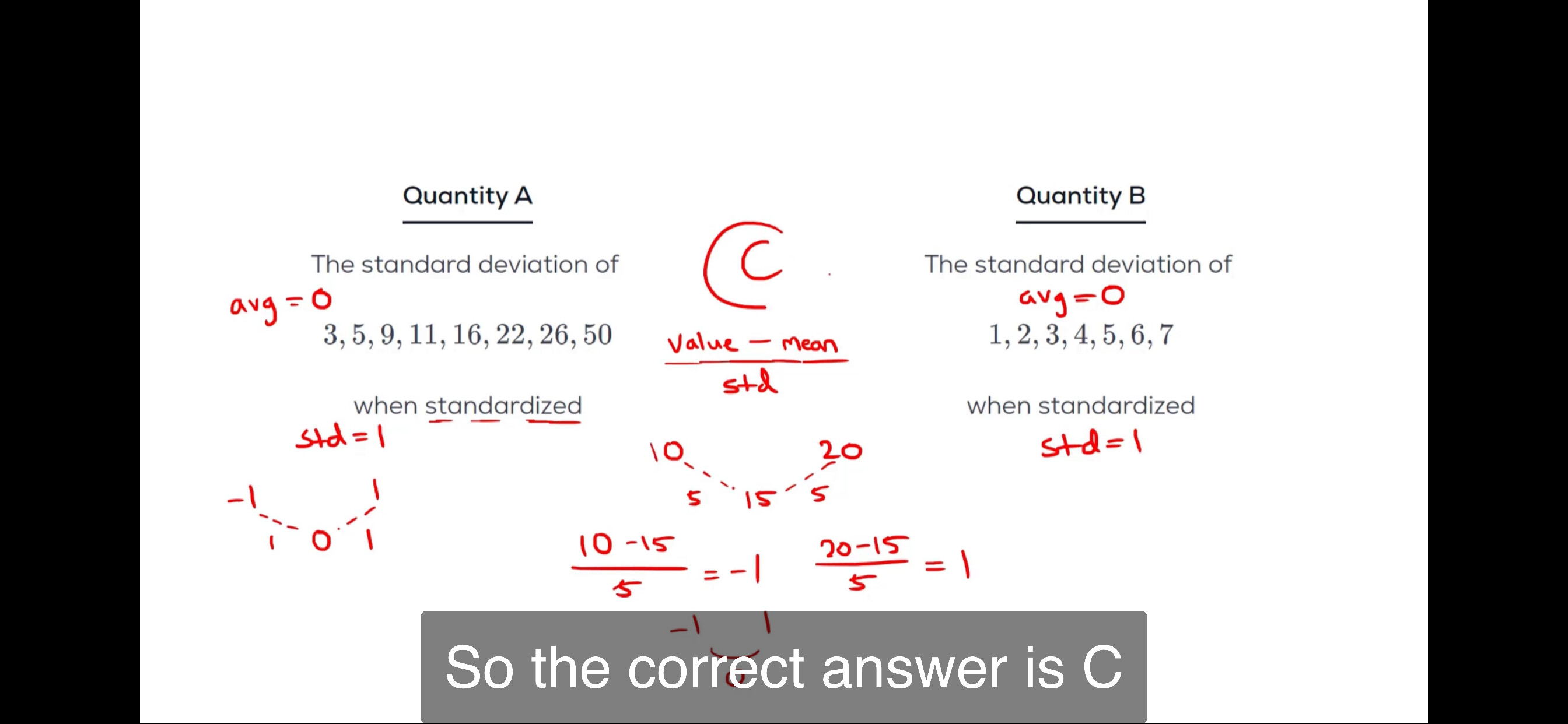
Hello, in the question below, Greg mentions that no matter how many elements we have in a list, and no matter what the values are, we always have the same SD for the standardized elements because they all add up to zero.
I tried to confirm this by selecting 4 elements from list A (9, 11, 16, 22) and 3 elements from list B (3, 4, 5). Then I went through the hassle of calculating the standardized value of each of these elements. The result was, standardized elements in A (-1.37, -0.99, -0.06, 1.06) and the standardized elements in B are as follow (-1.22, 0, 1.22). Then I calculated the SD of standardized list A, which resulted in 0.94; and the SD of the standardized list B resulted in 0.7. So, as you can see, I ended up showing that SD of standardized A is greater than that of B.
To be honest, this makes more sense to me because each list has its own spacing. And as we know, standardization just tells you how far away each element is from the mean. So, if elements are more spaced out, this results in having higher value of SD and higher value of standardized distance.
Am I missing something here?
Standardization refers to the “idea” of rescaling the data to have a mean of 0 and standard deviation of 1, so by definition the answer should already be C.
However, if you’re not convinced, you can have a look at this:
If you’re still not convinced, then you can assert this mathematically.
Let the standard deviation of an arbitrary list be \sigma, then:
-
The standard deviation when you shift each element mean units down is unchanged because translation of data points doesn’t affect dispersion
-
If you multiply each element by some constant c, then the standard deviation is scaled by |c|. In our case, we are scaling down by \frac {1}{\sigma}, so our new standard deviation is \frac 1 \sigma \cdot \sigma = 1
In general, \operatorname{SD}(Ax + B) = |A| SD(x) or alternatively \sigma_{Ax + B} = |A| \sigma_x.
This is the effect of the standard deviation when you apply a linear transformation (scaling + translation) to the data. The only thing that affects the standard deviation is the scaling factor.
Thanks for your response. I appreciate it. I kind of start to close the gap. But, one thing doesn’t make sense to me. After rescaling a certain list of two elements, let’s assume the standardized values would be like this: -0.25, +0.25. They add up to zero. And their mean is zero. Since these are only two elements, then the SD of the standardized list is equal to the distance between either of these elements and their mean. In this case, the SD of the standardized list would be 0.25, not 1 as it should be.
The standardized data can not possibly be [-0.25, 0.25] because the standard deviation of this isn’t 1. The mean part checks out, but not the standard deviation.
To reiterate, each data point is “subjected” to this action:
X_{\text{new}} = \frac{X - \mu}{\sigma}
Also, “adding up to 0” is informally equivalent to saying the mean is 0, so i’m not sure why you mentioned both of them separately.
1 Like