@Kweku got the gist - but
how’d we know if discredited hypothesis = error? or probable truth
it definitely is kind of a stretch to match the logic here or simplify the second sentence to replace with discredited hypothesis
if lets say we cant match those/ opposite match those -
do you think that ‘but’ in the first sentence can help us solve this alone? or if we are not able to identify the ‘blocks’ what do u recommend we do
@gregmat if u can also share your thoughts on this question!
how’d we know if discredited hypothesis = error? or probable truth
it definitely is kind of a stretch to match the logic here or simplify the second sentence to replace the phrase, we can end up matchiing wrong too
So we can simplify the structure to:
Supporting evidence is more satisfying to report
BUT
*Errors are more likely to be _____ than supporting evidence.
*
if lets say we cant match those/ opposite match those -
do you think that ‘but’ in the first sentence can help us solve this alone? or if we are not able to identify the ‘blocks’ what do u recommend we do
@gregmat if u can also share your thoughts on this question!
In the future, I recommend putting one question per post
sure @gregmat for now, just this one is stuck, rest all solved
not able to understand how
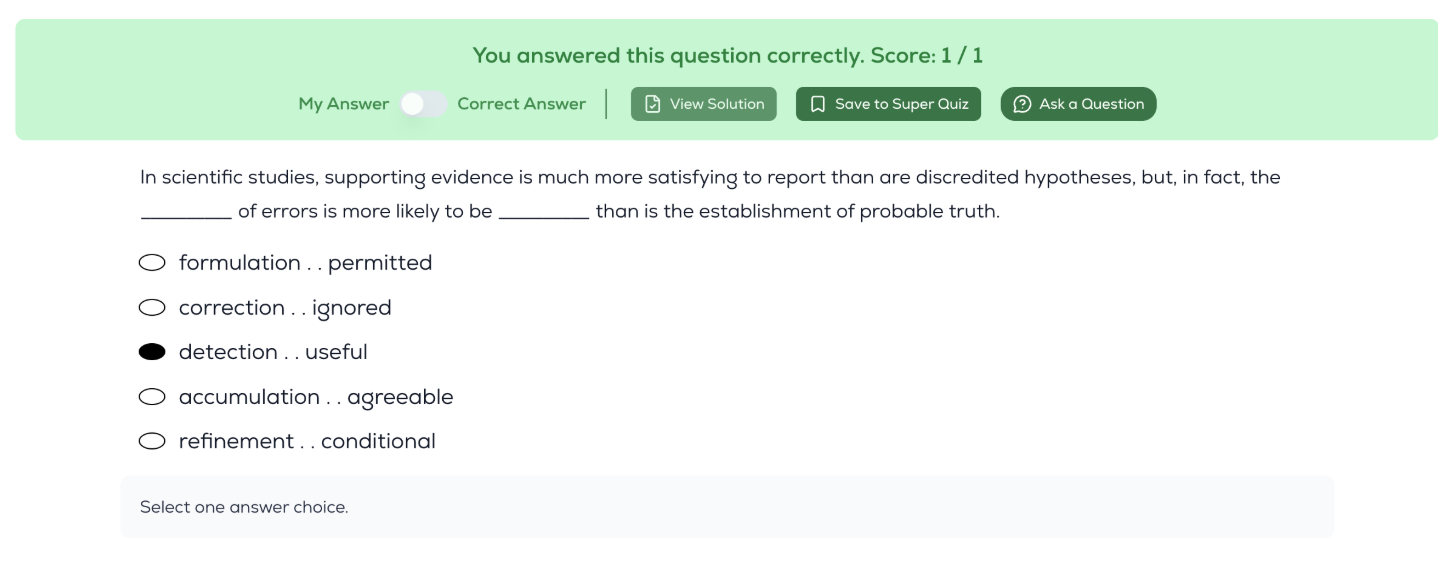
question is:
how’d we know if discredited hypothesis = error? or probable truth
it definitely is kind of a stretch to match the logic here or simplify the second sentence to replace with discredited hypothesis
if lets say we cant match those/ opposite match those -
do you think that ‘but’ in the first sentence can help us solve this alone? or if we are not able to identify the ‘blocks’ what do u recommend we do
The first idea says “supporting evidence” is better than “discredited hypotheses,” and then we have the “but.” That tells us that “discredited hypotheses” are actually useful in some way. So the second idea (including both blanks) has to say that these “discredited hypotheses” are useful in some way.
The formation of errors is permitted…nothing about permission
The correction of errors is ignored…literally the opposite of what we’re looking for
The detection of errors is useful…LOOKS GOOD
The accumulation of errors is agreeable…people are “agreeable” – not really “accumulation of errors.” Even if this was correct, there is no evidence about “accumulation”
The refinement of errors is conditional…conditional on what? The sentence has nothing about conditions
thank you greg!!!
but a follow up here: @gregmat
how do we know ___ of errors = discredited hypothesis (not necessarily every discredited hypothesis or ideas might be erroneous ? )
is BUT enough proof to say that whatever is coming AFTER BUT flips. the IDEA?
Or could it also be
that _____ errors is bad & probable truth is good? The ideas are reversed but the mapping is opposite - so if we are not able to coorelate error with discredited hypo, is BUt enough to say that the next term ‘errors’ is bad?
While you might not be wrong, which answer choice is better? Remember it’s not enough to say the correct answer choice is insufficient. You also have to indicate which answer choice is better and why.
Thank you so much Greg!! it is clear now