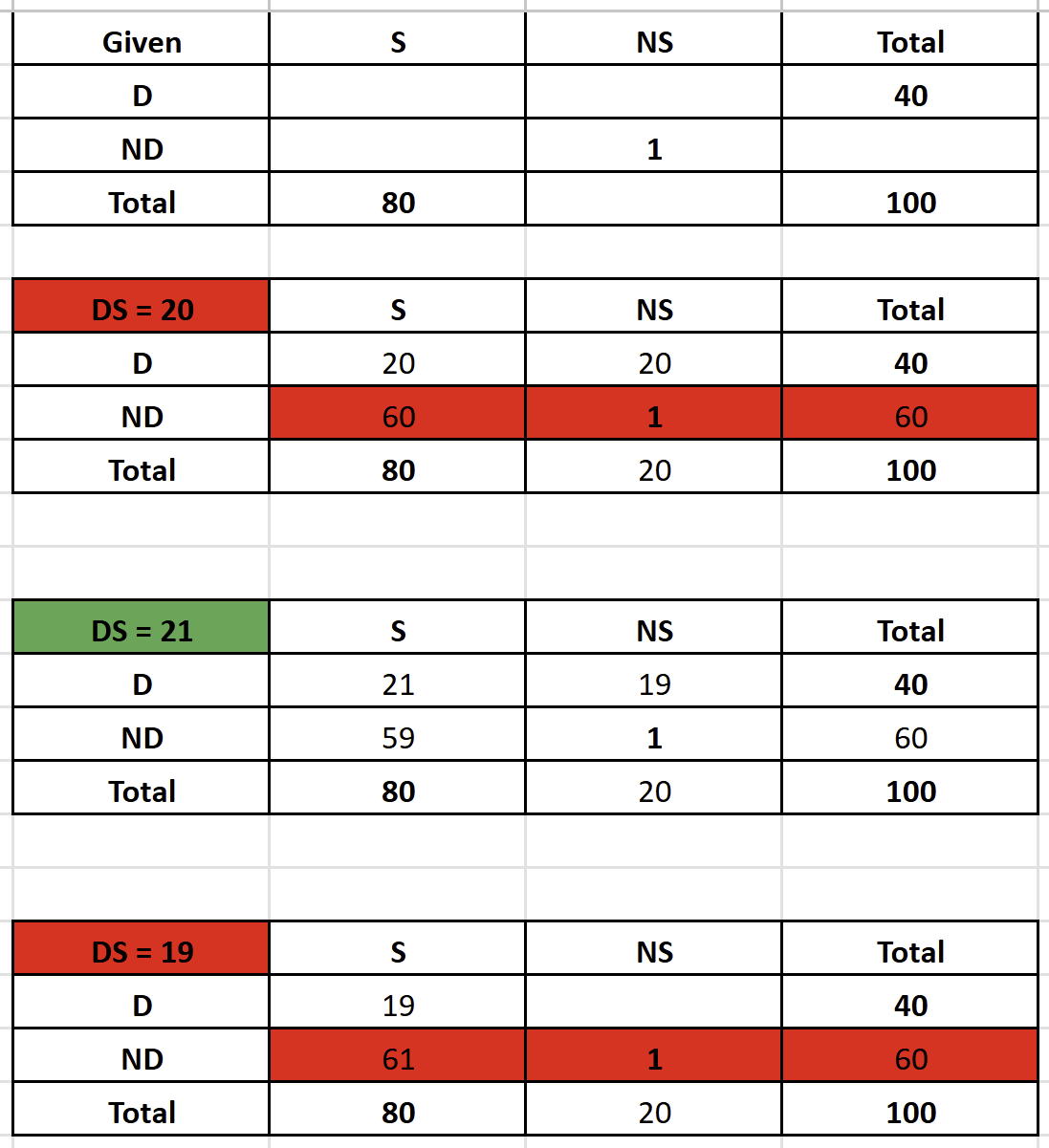
Not really. We’ll look at how disjunctions (how the word “or” actually works) function below:
Suppose you have three categories (propositions) A, B, and C. Technically, the problem lists 4 categories, but the logic holds for any n number of categories/propositions. The following is the truth table for the “inclusive or” (the type of disjunction you’re dealing with):
\begin{array}{|c|c|c||c|}
\hline
A & B & C & A \lor B \lor C \\ \hline
T & T & T & T \\ \hline
T & T & F & T \\ \hline
T & F & T & T \\ \hline
T & F & F & T \\ \hline
F & T & T & T \\ \hline
F & T & F & T \\ \hline
F & F & T & T \\ \hline
F & F & F & F\\ \hline
\end{array}
As you can see, the disjunction (the result in the final column) is true as long as at least one of the individual components is true. It does not require that every category must be “true” (actually used) for the statement to hold.
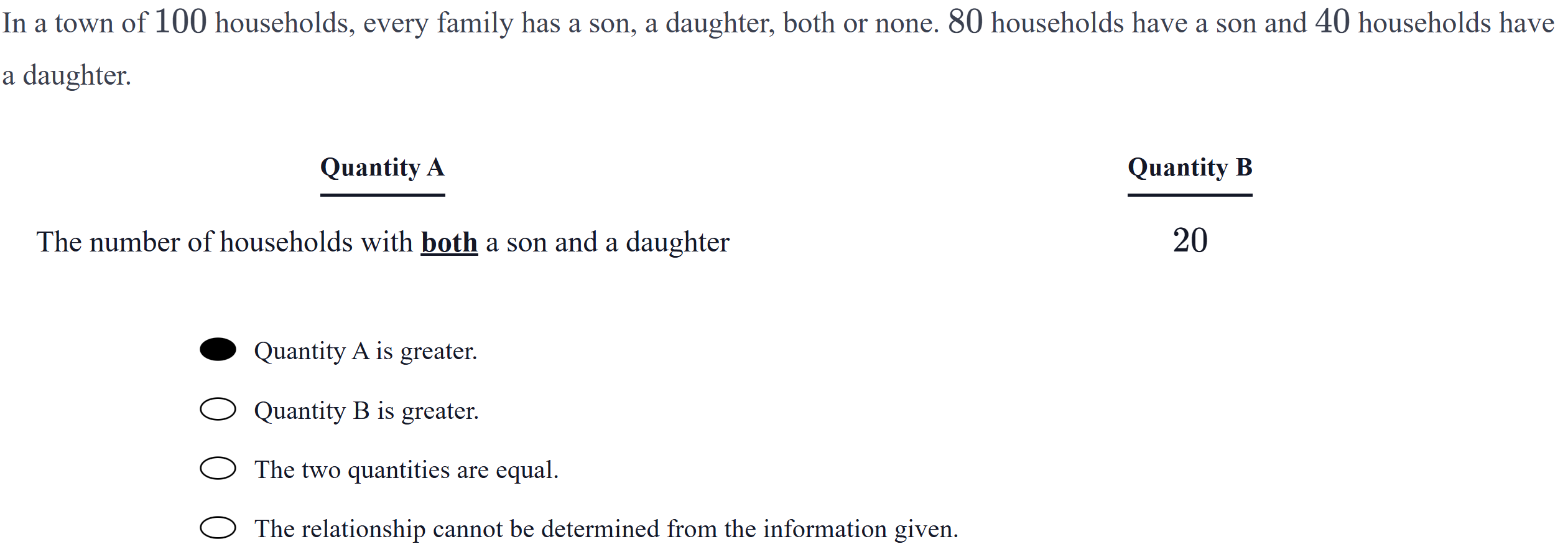
Coming back to the question, the statement “every family has a son, daughter, both, or none” essentially says that every family must fall into one of these four buckets:
- Has a son
- Has a daughter
- Has both
- Has none
As long as a family fits into at least one of these buckets, the town’s rule is satisfied.
More formally: (“has son” \lor “has daughter” \lor “has both” \lor “has none” ) = ( T \lor T \lor T \lor F ) = T
Crucially, listing a bucket (like “None”) doesn’t mean you are forced to put a family in it. It just means the bucket is available for use.
In other words, the “has None” bucket being False (F) doesn’t make the town’s rule False.
TL;DR: When statements are connected by an “or,” only one of them needs to be true for the whole statement to be true.